Get Full Government Meeting Transcripts, Videos, & Alerts Forever!
Get email alerts on the Wireless Small Cells topic
No spam. Unsubscribe anytime.
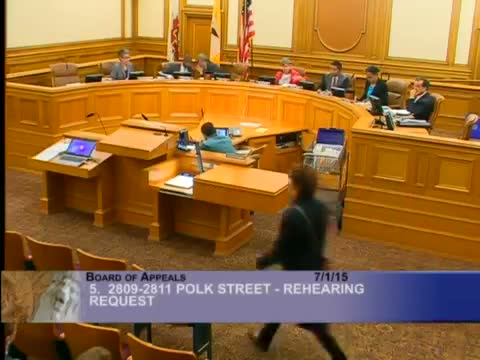
Board of Appeals upholds several small-cell permits despite neighborhood objections in Russian Hill and North Beach
Summary
The San Francisco Board of Appeals on July 1 upheld multiple Department of Public Works permits for small-cell wireless installations after sustained public comment from Russian Hill and North Beach residents who said the pole-mounted equipment would block views and degrade streetscapes. Planning and Public Health staff said installations complied with Article 25 and FCC-based safety checks.
SAN FRANCISCO — The San Francisco Board of Appeals on Wednesday upheld a series of Department of Public Works permits for small-cell wireless equipment in Russian Hill and North Beach despite hours of testimony from residents who said the installations would obstruct private views and harm the character of landmark streets.
The board heard multiple appeals, including a contested permit for 2215 Leavenworth Avenue submitted by Extonnet (for Verizon Wireless) and several related sites proposed nearby. Appellants Anne and Randall Brubaker told the board the canisters and equipment "will obstruct our view, period" and urged the board to apply the permit condition that the facility "shall not obstruct the view from or light into any adjacent residential window." Nicole Mason, representing the permit holder, said the installations were designed to minimize visual impact and stressed the citywide network needed to address doubling demand for mobile data and local coverage gaps.
Planning Department wireless planner Omar Mazri told commissioners the department reviewed the sites under Public Works Code Article 25 and worked with the applicant to reduce pole-height increases and streamline equipment placement. "We treated every street view as if it was an excellent street," Mazri said, adding that the designs were revised after protests to reduce visibility from residences.
Public comment spanned residents and local groups. Critics argued the photo simulations did not show views from inside some homes, and that notification and protest tallies were sometimes inconsistent. Several speakers also raised concerns about long-term radio-frequency exposure and urged the city to apply the 2003 Precautionary Principle. Supporters of the permits said the small facilities — described by counsel as roughly a 24-inch tall antenna canister with compact radio units — provide improved coverage and safety benefits, and that Department of Public Health review and post-installation testing were part of the approval process.
Paul Albritton, outside counsel for Verizon Wireless, told the board the equipment is small — the canisters are about 24 inches high and 15 inches in diameter and the radio boxes are roughly 10 by 6 by 17 inches — and the planned network of dozens to hundreds of sites is engineered to keep exposures far below federal limits. "These are 61‑watt facilities," Albritton said, and the RF reports show the sites would operate well under Department of Public Health and FCC guidelines.
The legal framework shaped discussion. Commissioners repeatedly noted that Article 25 sets a planning and compatibility standard, and that the board’s role on appeal is to determine whether the Planning Department’s Tier B compatibility findings were correctly made. That standard asks whether a facility would "significantly detract from the defining characteristics of the residential or neighborhood commercial zoning district" or "significantly impair" public views that form the basis of the general-plan designation.
After deliberation the board moved to uphold the DPW decisions on the challenged permits. On the Brubaker site (2215 Leavenworth) the motion to deny the appeal and uphold the permit passed on a 5‑0 vote; later related appeals of small-cell permits on Jones Street, Chestnut and other streets were also upheld in separate votes.
The board left open post‑installation remedies. Planning staff and DPW officials noted that if a facility is later found to violate an agreed condition (for example, if installed hardware differs materially from approved plans and causes a demonstrated obstruction), the department can pursue notice-of-deficiency procedures, modifications or revocation. "If it is found in the field not to meet the condition of approval, there can be proceedings to modify or remove the pole," counsel for Extonnet said.
The decisions resolve a wave of appeals that grew out of a multi-site buildout of compact wireless facilities in San Francisco. Commissioners expressed sympathy for residents’ aesthetic concerns while citing limits on local authority under federal and state law — and the procedural standards in Article 25 — in balancing community character and the need for increased wireless capacity.
What’s next: some residents said they plan further administrative or legal steps if they believe installed facilities deviate from approved plans; DPW and Planning said they will continue to monitor complaints and perform post‑installation inspections and RF testing.