Get Full Government Meeting Transcripts, Videos, & Alerts Forever!
Get email alerts on the Urban Forestry topic
No spam. Unsubscribe anytime.
Board of Appeals upholds DPW permit to remove two eucalyptus trees at Dogpatch site with replacement‑tree condition
Summary
The San Francisco Board of Appeals on July 2 upheld a Department of Public Works permit allowing the removal of two eucalyptus trees at 2051 Third Street (also cited as 650 Illinois Street) to allow a 93‑unit project to proceed, voting 4–0 and requiring 48‑inch replacement boxes (60‑inch if feasible).
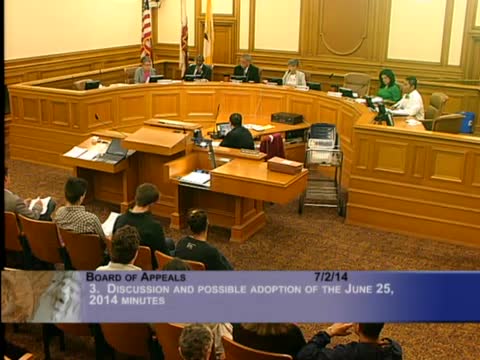
The San Francisco Board of Appeals on July 2 voted 4–0 to uphold a Department of Public Works permit allowing the removal of two eucalyptus trees at 2051 Third Street (also referenced as 650 Illinois Street) after hearing expert testimony, neighbors’ objections and developer arguments. Vice President Arceli Hurtado moved to uphold the permit with a condition that replacement street trees be planted in 48‑inch boxes and, where possible, 60‑inch boxes to be determined by the Department of Public Works; Commissioners Frank Fung, Daryl Honda and President Anne Lazarus voted aye.
The decision clears the way for Raintree Partners’ approved residential project, a 93‑unit building that the developer said would lose roughly 15 units (about 16% of density), 16 below‑grade parking spaces (about 20% of the project’s parking) and at least two on‑site below‑market‑rate units if the trees were retained. Rick Price of Raintree Partners told the board DPW’s January permit reflected inspectors’ findings that the eucalyptus exhibit poor structure, compromised roots and prior limb failures; he said the project will plant five Magnolia trees along the frontage after removal.
Appellants and neighbors strongly opposed removal. Appellant Topher Delaney said the appeal concerned only the two trees and cited the San Francisco Urban Forest Plan and testimony from independent arborists, arguing the trees are neighborhood landmarks that provide shade, habitat and urban‑canopy benefits. “This is simply about two trees,” Delaney said, urging the board to focus on tree‑specific evidence rather than broader development policy.
Two arborists offered opposing professional assessments. Ray Moritz, a principal consulting arborist for Urban Forestry Associates, told the board that major structural roots extend beyond the raised planter beds, that the trees support wildlife and that professional maintenance could reduce risk. “They are safe trees and they can be made even structurally better and more attractive with a little professional attention,” Moritz testified. By contrast, Roy Leggett, a consulting arborist retained by the permit holders, described a failure pattern of multiple limb breaks and said the trees’ prior topping and brittle wood make them prone to future large limb failures over the public right‑of‑way.
Carla Short of the Department of Public Works said DPW inspectors and certified tree‑risk assessors found structural problems, noted root lift damaging adjacent public access areas and concluded the trees’ condition supported issuing the removal permit. DPW also noted the trees are on private property and that the approved project received unanimous planning‑commission approval on June 5.
Several neighbors, including Amy Bickerton and Jake Reinfrank, urged the board to revoke the permit, describing the trees as essential to the Dogpatch streetscape and arguing replacement magnolias would not provide the same canopy or habitat for decades. Rob Poole of the San Francisco Housing Action Coalition urged the board to allow the project to proceed, saying it matches neighborhood and city housing goals.
After deliberation the board adopted Vice President Hurtado’s motion to uphold the permit with the stated replacement‑tree box‑size condition. The board recorded the motion as adopted 4–0; DPW will determine whether the 60‑inch boxes are feasible at the site.
The board moved on to other business following the vote.