Get Full Government Meeting Transcripts, Videos, & Alerts Forever!
Get email alerts on the Housing Bmr Conversion topic
No spam. Unsubscribe anytime.
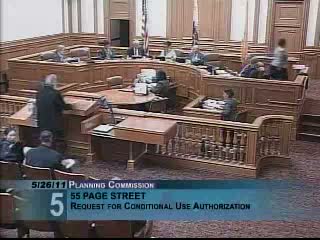
Planning Commission approves conversion of 17 voluntary BMR rentals at 55 Page Street amid legal uncertainty
Summary
The Planning Commission voted 4–3 on May 26 to allow a developer to convert 17 voluntarily dedicated below‑market‑rate (BMR) rental units at 55 Page Street to for‑sale BMR units. Advocates sought a fuller hearing and legal guidance about whether the Palmer decision or other rules prevent the change; the deputy city attorney said Palmer likely applies and legal questions will be addressed in closed session.
The San Francisco Planning Commission on May 26 approved a request to convert 17 voluntarily dedicated below‑market‑rate (BMR) rental units at 55 Page Street into for‑sale BMR units, a decision that split the commission and drew sharp public comment.
Planning staff presented the proposal as consistent with the city’s inclusionary housing program and noted the units were never rented. Project representative Craig Hamburg told the commission “we have not actually made any efforts to rent the units,” and said homeowners and the building sponsor support a conversion to for‑sale ownership to help financing and long‑term building stability.
Tenants’ advocates, led by Dean Preston of Tenants Together, urged the commission to hold a fuller hearing and to get a formal legal opinion before approving any change. Preston said the units were voluntarily dedicated as rentals in 2000 and warned that converting them threatens promises of affordable rental housing. Staff and several commissioners acknowledged the tension between voluntary past commitments and current rules.
Deputy City Attorney Susan Cleveland Knowles told commissioners the Palmer decision affects the city’s authority over rental BMR requirements and that “most of those issues are best addressed in closed session,” saying Palmer “would most likely apply here.” Commissioners asked that the legal questions be resolved and discussed in an appropriate venue.
After extensive questioning and public comment, Commissioner Antonini moved to approve the conversion; the motion carried on a 4–3 roll call (Ayes: Commissioners Antonini, Gordon, Fong and Miguel; Noes: Commissioners Moore, Seguin and Olague). Commissioner Antonini argued the conversion remains within the city’s inclusionary framework and that the mayor’s Office of Housing supports the conversion as an on‑site option under current law.
The commission’s action was narrow: it approved the specific request for 55 Page Street as presented; the deputy city attorney and commissioners said the broader legal implications — including how the Palmer decision affects voluntary commitments made before the city’s current inclusionary ordinance — will be analyzed in closed session and by the city attorney’s office. The commission did not adopt a general new precedent on previous voluntary dedications.
What’s next: The city attorney will evaluate whether and how Palmer and other precedents constrain the city’s options; any formal legal findings or policy revisions would be addressed separately. The conversion approval is effective as a project decision subject to any timely appeals and to compliance with any applicable recording or monitoring requirements the commission or relevant city agencies impose.