Get Full Government Meeting Transcripts, Videos, & Alerts Forever!
Get email alerts on the Public Infrastructure topic
No spam. Unsubscribe anytime.
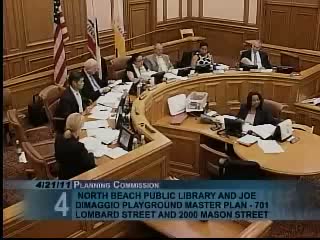
Planning commission certifies North Beach Library EIR and recommends rezoning of 701 Lombard
Summary
After hours of public comment both supporting and opposing, the Planning Commission certified the final EIR for the North Beach Public Library and Joe DiMaggio Playground master plan, adopted CEQA findings (6–1), and recommended rezoning 701 Lombard to a public/open‑space district with related street‑vacation and park improvements; staff noted unavoidable historic‑resource impacts requiring a statement of overriding considerations.
The Planning Commission certified the final environmental impact report (EIR) for the North Beach Public Library and Joe DiMaggio Playground master plan (case 02/2008.0968E) and approved related land‑use findings and a zoning recommendation to enable the project to move forward.
Staff described the project scope as vacation of a 195‑linear‑foot portion of Mason Street, demolition of the existing branch library at 2000 Mason Street, construction of a new approximately 8,000–8,500 square‑foot branch library at 701 Lombard Street (the triangular “triangle” parcel), landscaping and park improvements and upgrades to the Joe DiMaggio playground. Staff and Rec & Park said the plan would create about 12,000 square feet of new public open space and increase the children’s play area by roughly 3,000 square feet.
The hearing drew substantial public comment both for and against certification. Opponents argued the EIR and responses to comments were inadequate, raised concerns about demolition of a building eligible as a historic resource, asserted view‑corridor and public‑right‑of‑way encroachment (including a claimed 19‑plus‑foot intrusion), questioned eminent‑domain and open‑space‑fund legal constraints, and suggested alternatives that would retain or expand the existing library footprint. Supporters — including neighborhood groups, architects, and Rec & Park staff — said the EIR is thorough, the project would provide badly needed open space and modern library services, and a temporary Mason Street closure pilot suggested traffic impacts could be managed.
Michael Jacinto of the Planning Department’s environmental planning division told the commission the EIR analysis identified unavoidable, significant impacts to historic resources from the demolition. Staff recommended certification of the EIR as adequate, accurate and complete, noted a reasonable range of alternatives had been considered, and said a statement of overriding considerations would be needed if the commission approved the project despite unavoidable impacts.
Commissioner Miguel moved to certify the final EIR; the motion passed on the record. The commission later took three related actions: it adopted CEQA findings (including the mitigation monitoring and reporting program and the required statement of overriding considerations) on a recorded 6–1 vote, and then approved general‑plan consistency findings and a recommendation to rezone 701 Lombard Street to a P (public) and OS (open‑space) district and to remove the playground parcel from certain special‑use overlays. Commissioners discussed minor wording changes (for example, location options for an interpretive display) before approving the zoning‑related motions; those measures passed as recorded.
The record reflects deep community engagement and disagreement: preservation advocates argued for alternatives that would preserve or partially preserve the existing Appleton‑and‑Wolford‑era branch, while library and parks officials emphasized service equity, seismic and ADA upgrades, and the integrated park‑library civic space. The commission’s certifications and recommendations advance the project to subsequent legislative and permit stages, subject to the mitigation measures and the oversight spelled out in the adopted findings.