Get Full Government Meeting Transcripts, Videos, & Alerts Forever!
Get email alerts on the Parking Policy topic
No spam. Unsubscribe anytime.
Planning Commission backs SOMA parking reform, asks staff to refine TDM language
Summary
The San Francisco Planning Commission voted to support an ordinance removing minimum parking requirements and establishing maximums in parts of South of Market, while directing staff and the city attorney to refine language on transportation demand management for larger venues. The motion passed with one dissent.
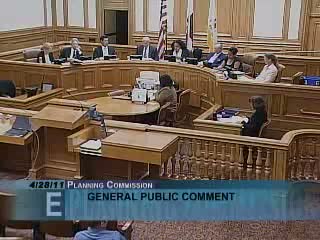
The San Francisco Planning Commission on April 28 voted to support an ordinance aimed at changing parking rules in parts of South of Market, directing staff and the city attorney to refine language about applying transportation demand management (TDM) requirements to larger nonresidential projects.
The ordinance, originally introduced by Supervisor Daly and advanced by Supervisor Kim, would remove minimum parking requirements and establish maximum parking limits in targeted SOMA districts, adjust pricing to discourage long-term commuter parking and allow reduced parking by right in areas near transit. April Veneracion, legislative aide to Supervisor Kim, said the office would remove two Mission Bay block numbers from the ordinance and work with small-business stakeholders on TDM applicability.
Tom Radulovich of Livable City, who helped shape the measure, told commissioners that limiting parking can change how people travel. "If you had a lot less parking in a project, you had a lot less drive alone," he said, urging the commission to consider transportation impact fees that reflect parking intensity.
Commissioners discussed trade-offs at length. Opponents warned that reductions in residential parking could leave projects without parking that residents need; supporters said pricing and targeted TDM rules could reduce commuter parking and support neighborhood livability. Commissioner Michael Antonini cast the lone vote against the motion, expressing concern that permitting lower residential parking ratios could lock in restrictions that some future projects would need to exceed as a right.
The city attorney read a proposed amendment to the commission’s motion clarifying that staff should "explore the proposal to limit the applicability of transit demand management requirements to larger venues and its application to particular uses, and return recommended language". The commission approved the motion with that instruction.
Next steps include staff drafting the final motion language for the Board of Supervisors and coordinating with the city attorney and affected supervisors. Commissioners also suggested a joint hearing with the MTA to examine transit capacity and nexus studies that link development and transit impacts.