Get Full Government Meeting Transcripts, Videos, & Alerts Forever!
Get email alerts on the Housing Policy topic
No spam. Unsubscribe anytime.
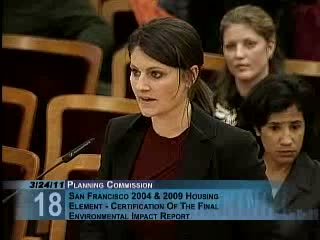
Planning Commission certifies Housing Element EIR and adopts 2009 housing policies amid protest
Summary
After extended public comment on transit, water supply and neighborhood character, the Planning Commission certified the final EIR for the 2004/2009 Housing Element and adopted the General Plan amendments and policy language with HCD‑requested clarifications; staff said some 2025 cumulative transit impacts remain significant and unavoidable.
The Planning Commission on March 24 certified the Final Environmental Impact Report (EIR) for the update to San Francisco’s housing element and adopted the related General Plan amendments after extended public testimony and policy debate.
Planning staff explained the EIR analyzed growth consistent with ABAG regional projections and the SFPUC’s 2009 water‑supply assessment. Staff told commissioners the Housing Element itself does not rezone land or automatically increase residential density; instead, it establishes policy guidance and implementation programs and is designed to meet the state’s RHNA regional allocation. The EIR identified potential 2025 cumulative transit impacts that may exceed Muni capacity and concluded that, because planned transit projects’ funding and timing remain uncertain, those impacts are significant and unavoidable.
More than two dozen speakers urged the commission to delay certification or to recirculate the draft EIR. Primary concerns raised in public comment included the EIR baseline and methodology for traffic analysis, whether projected ABAG growth was an appropriate baseline, water‑supply adequacy in light of updated SFPUC planning documents, and last‑minute policy changes that expanded transit corridors to include additional bus lines. Several neighborhood groups asked the commission to reinstate the June 2010 draft or to limit policy changes affecting RH1/RH2 neighborhoods until additional environmental review was conducted.
Staff responded that the EIR used ABAG projections as required for regional planning comparisons and relied on the SFPUC’s water‑supply assessment rather than the 2005 Urban Water Management Plan; staff also explained that changes requested by the Department of Housing and Community Development (HCD) were narrow data and methodology clarifications and that the housing element does not itself rezone or entitle projects.
After discussion and a set of clarifying amendments (including HCD‑requested text and staff‑proposed wording to emphasize that neighborhood character guidance reflects existing built patterns and that major rezoning should be achieved through community‑based planning processes), the commission voted unanimously to certify the final EIR, adopt CEQA findings and adopt the Housing Element General Plan amendment. Commissioners asked staff to coordinate follow‑up briefings with the SFPUC on water supply and to continue interagency coordination on transit mitigation projects.