Get Full Government Meeting Transcripts, Videos, & Alerts Forever!
Get email alerts on the Treasure Island Redevelopment topic
No spam. Unsubscribe anytime.
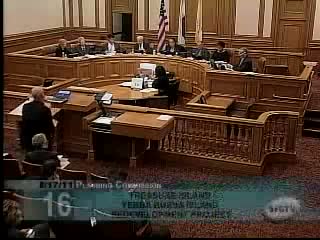
Planning staff briefs commission on Treasure Island/Yerba Buena Island redevelopment plan and next steps
Summary
Planning staff and the redevelopment team presented the Treasure Island/Yerba Buena Island draft land‑use plan, design‑for‑development guidelines, phasing and housing strategy for up to 8,000 homes (30% affordable). Commissioners and public commenters requested additional interagency coordination on transportation, Caltrans/Bay Bridge access and sea‑level rise/CEQA concerns.
San Francisco — Planning staff and the Treasure Island development team presented an informational overview of the Treasure Island/Yerba Buena Island redevelopment vision on Feb. 17, outlining land use, parks, sustainability goals, phasing and a housing strategy that aims for roughly 30 percent affordable units.
The plan centers a compact, walkable mixed‑use island with four neighborhood districts, a transit‑oriented island center, reuse of historic administration buildings and hangars, a new intermodal ferry/bus terminal, and a network of parks and green corridors that capture microclimate advantages. The development team displayed revised massing that reduces the campanile/tower heights compared with earlier drafts and refines bicycle/pedestrian links to the Bay Bridge approach.
Redevelopment staff said the proposed program foresees roughly 7,500 to 8,000 dwelling units in the EIR scenario, roughly two‑thirds market rate and 30 percent affordable using a mix of TIDA‑funded units, deeply affordable "tie‑dye" units (for formerly homeless households) and inclusionary on‑site units. The redevelopment plan anticipates using tax‑increment financing for infrastructure and dedicating portions of increment to housing. Project phasing envisions early infrastructure and sites near the island center and transit core, with full build‑out over 15–20 years depending on market conditions.
Public comment was broadly supportive of a civic museum and job‑training uses; labor speakers encouraged use of existing job‑training facilities. Environmental commenters applauded green ambitions but urged stronger explicit mitigation for sea‑level rise and liquefaction risk, pointing to more recent climate projections than used in the draft EIR. Planning staff acknowledged those concerns and noted additional upcoming hearings on transportation, parks, sustainability and EIR certification scheduled in March and April.
Commissioners asked staff to continue interagency outreach with SFPUC, SFMTA and the Port on transportation, utilities and ferry access; staff said those agency consultations are ongoing and further public hearings are scheduled. The project team also noted a governor’s redevelopment budget proposal could affect program financing and they are monitoring state actions.
What’s next: Staff will present additional informational sessions March 3 and March 7 on sustainability, transportation and parks, and the commission will consider initiating general‑plan and planning‑code amendments; EIR responses and certification are scheduled for April.
Representative quote: "We're moving from the planning and entitlement phase into implementation," said Rich List of the Office of Economic & Workforce Development. "We're excited to begin this project and begin implementing what we think is a very exciting project."