Get Full Government Meeting Transcripts, Videos, & Alerts Forever!
Get email alerts on the Regional Planning topic
No spam. Unsubscribe anytime.
Commission hears regional SB 375 briefing; advocates warn funding gap could undercut affordable housing and transit goals
Summary
Planning staff and regional transportation officials updated the commission on the Bay Area'wide Sustainable Community Strategy (SB 375) and associated Regional Transportation Plan work. Community groups warned the commission that without targeted funding for transit operations, affordable housing and infrastructure, compact growth could accelerate displacement in "communities of concern."
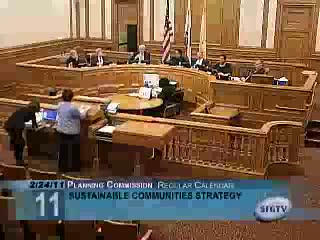
Planning Department and Transportation Authority staff briefed the San Francisco Planning Commission on Feb. 24 about the Bay Area'wide Sustainable Community Strategy (SCS) created under SB 375, highlighting regional targets and the schedule for scenario analysis and the regional transportation plan (RTP).
Tilly Chang of the San Francisco County Transportation Authority summarized the SCS'RTP integration and the region's AB 32-linked greenhouse gas reduction target (15% per capita by 2035). She described a four-stage process—vision, detailed scenarios, a preferred scenario, and environmental review—and noted that the RTP represents a multi-decade $200 billion investment plan that will prioritize projects in conformance with the SCS. The Transportation Authority announced a March 24 call for regional project ideas for the RTP.
Staff framed the SCS as an opportunity to align land use and transportation to reduce vehicle miles traveled, but several presenters and dozens of public commenters urged the commission not to assume compact growth alone will achieve equity or emissions goals without accompanying investment in affordable housing, transit operations, child care and other neighborhood infrastructure.
Speakers from the Council of Community Housing Organizations, Chinatown Community Development Center, Chuchu (affordable-housing coalition), and other affordable-housing and neighborhood advocates highlighted a projected shortfall of below-market-rate units in priority development areas and estimated hundreds of millions in funding gaps to meet RHNA and SCS-driven targets. "We need community stabilization policies," one advocate said, arguing that concentrating growth near transit can raise displacement risk if protections and funding are not in place.
Commissioners pressed staff on legal mechanics (how a jurisdiction can demonstrate alternatives to conformance and what penalties or incentives exist). Staff said SCS compliance is more about incentives and funding priorities than punitive measures: jurisdictions that conform may gain access to some discretionary regional transportation funds and limited CEQA streamlining; jurisdictions that do not conform lose those incentives.
The broader debate centered on whether the region will redirect discretionary funding to jurisdictions doing the heavy lifting on growth and whether there are viable regional funding mechanisms for transit operations. Several public speakers proposed tying project approvals to availability of transit and affordable-housing funding and urged developers and agencies to coordinate earlier with neighborhoods.
The item was informational; no commission vote was required. Staff recorded the public concerns and said they would continue to participate in the regional process, advocate for funding priorities for San Francisco, and support public outreach when ABAG and MTC release detailed scenarios.