Get Full Government Meeting Transcripts, Videos, & Alerts Forever!
Get email alerts on the Urban Agriculture topic
No spam. Unsubscribe anytime.
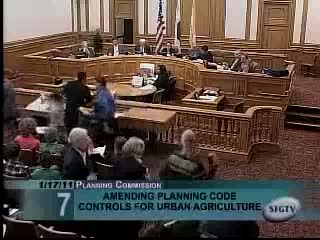
Planning Commission approves urban‑ag ordinance with amendments after hours of public support
Summary
The Planning Commission voted to forward an ordinance defining neighborhood and urban‑industrial agriculture, approving staff changes on fencing, fees and sales rules and asking staff to explore value‑added sales and soil testing. The decision follows hours of public testimony from gardeners, small‑farm entrepreneurs and agencies.
San Francisco — After a multi‑hour hearing and a packed public turnout, the San Francisco Planning Commission voted to approve amendments to the planning code that create a formal urban‑agriculture use category and split it into "neighborhood agriculture" and "urban industrial agriculture," commissioners said at the Feb. 17 meeting.
The commission’s approval included three clarifications requested by staff and members: that fencing would be optional and need not be opaque, that staff should continue to examine whether on‑site value‑added products can be permitted under existing health‑code rules, and that the department evaluate fee structures to reduce costs for temporary community garden uses.
Johanna Parton, director of climate protection initiatives in the mayor’s office, told the commission the ordinance advances the city’s Healthy and Sustainable Food directive and would "promote healthy locally grown food for all residents" while supporting local green jobs. "We are supportive of the ordinance before you," Parton said during the presentation.
The San Francisco Public Utilities Commission urged the commission to cross‑reference the city’s water‑efficient irrigation rules so urban gardens comply with existing water budgets. Bart Broom, government affairs manager for the SFPUC, said irrigation plans for planted areas over 1,000 square feet will need SFPUC approval before permits are issued.
Advocates and neighborhood gardeners filled the hearing room in force. Eli Zegas of the San Francisco Urban Agriculture Alliance said his group supports the department language and additional proposals to remove fees and fencing requirements for small plots. "For the most part, we are talking about gardens — small scale — not industrial farms," Zegas said. Garden operators, beekeepers and small‑farm businesses described narrow profit margins and urged rules that would allow modest sales and limited pooled produce at farm stands.
Commissioners debated enforcement, potential commercialization of residential blocks and public‑safety concerns such as water use and pesticides. Commissioners repeatedly pressed staff on differentiating temporary versus permanent uses and on whether a new use category would prompt additional inspections or Department of Public Health requirements.
Diego Sanchez of the Planning Department said the proposed ordinance would generally permit neighborhood agriculture in all zoning districts and require conditional use authorization for higher‑intensity "urban industrial" operations, while preserving fees under Article 3.5 of the planning code. He told the commission the department does not recommend waiving fees but will explore lower temporary‑use fees for short‑term garden activations.
The commission’s approval was accompanied by explicit direction for staff to report back on whether value‑added goods could be allowed consistent with health‑code rules, to explore simplified water‑efficiency compliance for small gardens and to consider a soil‑testing strategy for lots where contamination is a concern. Commissioners also asked staff to consult with the mayor’s office on options to help small growers reach markets without creating full‑scale retail uses in residential neighborhoods.
The ordinance record shows broad neighborhood and organizational support, with dozens of speakers urging passage and suggesting targeted amendments. The commission’s amended motion passed at the hearing; staff will forward the final ordinance language to the Board of Supervisors for consideration.
What’s next: The Planning Department will craft implementing language to reflect the commission’s direction on fencing, fees, soil testing and possible inclusion of value‑added sales, and will return the final ordinance to the Board of Supervisors and other city agencies for subsequent approvals.