Get Full Government Meeting Transcripts, Videos, & Alerts Forever!
Get email alerts on the Park Merced Redevelopment topic
No spam. Unsubscribe anytime.
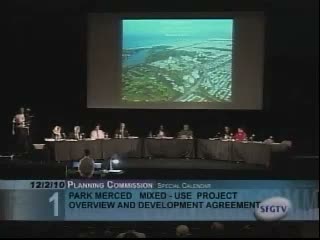
San Francisco planning hearing on Park Merced draws hundreds; residents warn of displacement as supporters tout transit funding
Summary
At a December 9, 2010 informational hearing, hundreds of Park Merced residents and stakeholders urged the Planning Commission to reject or substantially modify the redevelopment plan, citing loss of rent‑controlled homes, 20–30 year construction impacts, seismic and traffic risks; supporters emphasized $100M‑plus Tier‑5 transportation investment and green design.
The San Francisco Planning Commission heard more than three hours of public testimony on Thursday about the proposed Park Merced mixed‑use redevelopment, with long‑term residents warning that the plan would bulldoze thousands of rent‑controlled garden apartments and displace families, while other neighbors and community groups highlighted substantial transportation and environmental investments.
Joshua Switsky of the Planning Department framed the session as the third of four informational hearings on the Park Merced project and said staff planned future briefings on transportation and housing; commissioners subsequently agreed to hear detailed transportation and housing presentations at the next meeting and to keep initiation on the calendar but likely continued pending those presentations.
Residents and tenant advocates said the scale and pace of the proposal threatens established households. "I lived there for 30 years. I'm not gonna be evicted from it because landlords wanna make some more money," said Robert Pender, president of the Parkland Residents Organization. Multiple speakers said the developer’s promises to replace rent‑controlled units are legally fragile; Dean Preston of Tenants Together and other experts warned that state law and recent court decisions, including cases cited by speakers such as Embassy LLC and Lincoln Place, make written assurances difficult to enforce in court.
"There's simply no guarantee of enforceability," Preston said, urging the commission not to approve mass demolition of rent‑controlled housing without statutory protections or clear legal authority.
Speakers outlined concrete numbers used in the plan and EIR: the draft development agreement projects an increase from roughly 3,200 existing units to about 8,900 total units (figures cited by commenters varied), and residents repeatedly flagged the plan’s multi‑decade phasing. "A 20 to 30 year timeline is simply unacceptable," Tenants Together and others told the commission, arguing prolonged construction would force tenants out or erode community ties.
Public‑safety and site‑risk concerns also surfaced. Several residents and an emergency‑services speaker referenced geologic maps and liquefaction potential near Lake Merced and said tall towers in that soil could raise seismic risk and rescue‑access problems; others raised asbestos and air‑quality worries tied to large‑scale demolition.
Not all testimony opposed the project. Saint Stephen’s Parish and other West‑Side stakeholders said the developer’s Tier‑5 transportation commitment—described in testimony as approximately $100 million for infrastructure and intersection improvements, with an opportunity to accelerate work via matching funds—could materially improve traffic safety along Nineteenth Avenue and support retail and neighborhood amenities. "This project will finally bring much needed funding for those improvements," Jeff Rocca of Saint Stephen’s said, while other residents praised the plan’s sustainability goals, including net‑zero water and energy targets mentioned by supporters.
Environmental groups pressed a different green critique: Howard Strass of the Sierra Club urged planners to factor demolition‑related greenhouse‑gas emissions and to explore lower‑parking alternatives to reduce auto trips, noting that parking provision drives parking demand in EIR analyses.
Commissioners acknowledged the breadth of testimony and requested further legal analysis and staff presentations. Planning Director staff said the transportation and housing materials that were not presented tonight would be scheduled next week; commissioners asked the city attorney and Rent Board counsel to address enforceability and relocation law questions raised by public speakers.
The commission did not vote on the development agreement or take a formal action at the meeting. Commissioners said they remain open to changes while they review the EIR, the draft development agreement (dated in public testimony as 11/03/2010) and evidence presented by tenants and community groups. The next hearing will include staff presentations on transportation and housing details and may carry the initiation item to a later date if issues remain unresolved.