Get Full Government Meeting Transcripts, Videos, & Alerts Forever!
Get email alerts on the Academy Of Art Enforcement topic
No spam. Unsubscribe anytime.
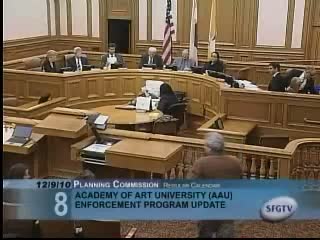
Planning staff reports progress on Academy of Art enforcement; commission plans code changes on student housing
Summary
Staff told the Planning Commission Dec. 9 that the Academy of Art University owns or leases 36 facilities (17 residential), has approximately 1,688 students in campus housing and that about 70% of required life‑safety permit work is complete. Commissioners asked staff to return with planning‑code amendments and an institutional master plan process in early 2011.
Planning Department staff on Dec. 9 delivered a wide‑ranging update on the Academy of Art University enforcement program and the university’s campus housing footprint, and commissioners directed staff to return with code amendments early next year.
Chris Hall, planning enforcement manager, told the commission the department has inventory showing 36 Academy facilities in the city, including 17 residential properties, and cited fall 2010 enrollment of 17,711 students with roughly 11,182 on‑site. The Academy reports approximately 1,894 bed spaces; the university’s contractor, Campus Living Villages, currently provides housing to about 1,688 students, roughly 9.5% of total enrollment.
Hall said inspections found life‑safety and accessibility violations; about 108 permits have been filed to correct those issues and roughly 70% of the required work is complete. "About 70% of the work has been completed," Hall said, noting ongoing coordination among planning, building and fire departments.
Public testimony ranged from support for the Academy’s community partnerships (Gail Roberts of the San Francisco LGBT Community Center described student volunteering and financial support) to sharp criticism from neighborhood residents and advocacy groups who said the university had converted housing stock without adequate oversight and had not been fully transparent about rent‑control implications. Francisco de Costa and other commenters urged stronger protections for rental housing and more aggressive enforcement.
Commissioners praised staff enforcement work and asked for targeted amendments. Commissioner Moore said she supported staff proposals to draft planning‑code changes that would prohibit some conversions of existing residential units into student housing and to define "student housing" more precisely. Staff agreed to return in the first quarter of 2011 with a package of code amendments and possible measures to prohibit conversions of residential hotels and require clearer institutional master‑plan provisions.
What happens next: Staff will continue enforcement work on life‑safety permits, proceed with scoping of the Academy’s EIR, and prepare planning‑code amendments (including a definition of student housing and potential conversion restrictions) for the commission’s review early in 2011.
Provenance: Staff presentation begins at SEG 2549 and commissioners conclude with direction for code amendments in SEG 3696.