Get Full Government Meeting Transcripts, Videos, & Alerts Forever!
Get email alerts on the Visitation Valley Fee topic
No spam. Unsubscribe anytime.
Planning Commission continues Visitation Valley fee overhaul to Feb. 3 amid boundary and crediting disputes
Summary
The San Francisco Planning Commission on Dec. 9 backed a motion to continue proposed amendments to the Visitation Valley Community Facilities and Infrastructure Fee to Feb. 3, urging the project sponsor and supervisor to resolve outstanding questions about in‑kind credits, distribution among Bayview/Visitation Valley/Executive Park and nexus-study details.
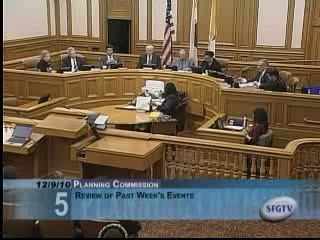
The San Francisco Planning Commission voted Dec. 9 to continue consideration of proposed amendments to the Visitation Valley Community Facilities and Infrastructure Fee until Feb. 3, 2011, after months of public concern about how the ordinance would allocate funds and credits among adjacent neighborhoods.
Planning staff presented changes intended to standardize the Visitation Valley fee with other city impact‑fee programs, update the supporting nexus study and clarify how in‑kind improvements may offset fees. Staff’s draft reduces the as‑of‑right in‑kind credit for community facilities and child care from 50% to 25% but allows a commission to approve credits up to 100% in specific cases, and clarifies eligible categories of expenditure for the fee.
Community leaders and developers urged the commission not to act immediately. Espinosa Jackson of Bayview Hunters Point and Shirley Jones, chair of the Executive Park advisory committee, said the proposal omitted outreach to communities whose geography and needs they say were overlooked when the supervisor’s office drew boundaries. "We are requesting that we hold a community meeting of all the communities of 94124 and 94134 so we can sit down and talk about it," Shirley Jones said during public testimony.
Developer representatives and others said sudden changes to crediting rules create uncertainty for projects now in negotiation. Michael Burke, representing a project sponsor, told commissioners the recently introduced amendments reduced negotiated as‑of‑right credits and left unresolved how the nexus study would allocate funds among transportation, parks and community facilities.
Several commissioners signaled support for the principle of standardization but said they needed more time to review the technical details. "We should support the standardization," Commissioner Antonini said, "but there are significant concerns about the present structuring of the revisions to the preexisting fee agreements, most specifically concerning the neighborhood center at Executive Park." Commissioner Moore said she was "in the dark" on aspects of Executive Park and wanted the commission to see a clearer nexus justification.
Given a 90‑day clock that limits how long the planning commission can hold an item, commissioners debated whether to take a nonbinding position or to continue the item. The commission ultimately voted to continue the matter to Feb. 3, with a comment that the supervisor — current or incoming — should work with all parties to resolve outstanding concerns. The motion passed 4–2.
What happens next: Staff will prepare revised materials and the supervisor’s office has been asked to coordinate community meetings and provide clarification of the nexus study and the mechanics of in‑kind crediting before the Feb. 3 hearing.
Provenance: Topic first introduced by staff (SEG 1315) and last discussed in the Feb. 3 continuance vote (SEG 2544).