Get Full Government Meeting Transcripts, Videos, & Alerts Forever!
Get email alerts on the Historic Preservation Code topic
No spam. Unsubscribe anytime.
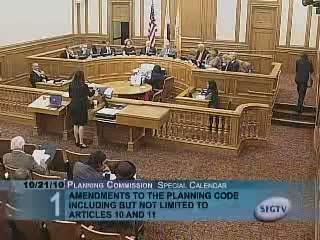
Commissions weigh rewrite of planning code articles for historic resources; public and commissioners press for more outreach
Summary
Planning Department and the Historic Preservation Commission presented proposed rewrites to Planning Code Articles 10 and 11 to implement Prop J and update landmark and historic-district procedures. Public speakers and several planning commissioners pressed for more time, clearer notice and appeals rules, safeguards for low-income neighborhoods, and local interpretation of preservation standards.
Tara Sullivan, a planning department staffer, told the joint session that the proposed amendments to Article 10 would modernize rules for nominating and initiating individual landmarks and historic districts, create an administrative certificate-of-appropriateness (C of A) pathway for minor work, standardize notice requirements and clarify appeals procedures. "Article 10 deals with citywide historic resources and individual landmarks, whereas article 11 only deals with the downtown," Sullivan said, and she outlined five topics the department wanted both commissions to focus on.
Why it matters: The changes would implement Proposition J’s creation of the Historic Preservation Commission and revise decades-old code language. Supporters say the updates will make review more consistent and reduce unnecessary hearings; opponents warn they could accelerate gentrification or leave residents with inadequate notice and no real say on district designations.
The package’s main technical changes include a clearer nomination and initiation process for landmarks (who may submit documentation and when the hearing must be scheduled), a two-tiered C of A system that delegates routine maintenance reviews to staff with a 15‑day notice and the option for HPC review, and revised notification distances (150 feet for individual landmarks, 300 feet for districts) and timing (20-day mailings for initial notice; a 10-day notice for second C of A hearings).
Public commenters and neighborhood groups urged more outreach and sharper equity protections. Sarah Karlinsky of the San Francisco Planning and Urban Research Association said the proposal’s year-long interim control for district initiations is "lengthy" and recommended restoring a 180-day baseline with limited extensions and stronger owner-consent safeguards for district creation. Bayview resident Espinola Jackson and other speakers said many homeowners in surveyed neighborhoods are unaware of the process and asked the commissions to hold neighborhood meetings before any designation moves forward. Josh Varsay of the Bright Line Defense Project warned that living under historic-district rules can be a burden that displaces low- and moderate-income homeowners.
Several commissioners echoed those concerns. Commissioner Christina Olague and others asked for additional hearings and staff briefings so the Planning Commission can fully digest the HPC’s revisions to what had been characterized as a "cleanup" package. Commissioner Alan Martinez, a sitting HPC member, said Prop J requires substantive changes and defended giving the HPC the power to initiate nominations while promising the commission will set transparent procedures for public participation.
What happened next: The Planning Commission voted to continue consideration of Articles 10 and 11 to allow more in‑depth review and public outreach. The motion passed 5–1 (Ayes: Antonini, Boyle, Moore, Olague, Miguel; No: Seguaya). Staff said it will schedule additional informational hearings and provide clarified drafts and supporting materials to commissioners and the public.
What’s next: The departments will schedule additional Planning Commission hearings to walk through Article 10 section by section, share revised draft language when the city attorney’s office finalizes form, and coordinate HPC representatives’ attendance. Any formal ordinance changes will ultimately be forwarded as recommendations to the Board of Supervisors, and the commissions said they expect more adjustments before final introduction.