Get Full Government Meeting Transcripts, Videos, & Alerts Forever!
Get email alerts on the Treasure Island Redevelopment topic
No spam. Unsubscribe anytime.
Public commenters press for more review of Treasure Island draft EIR; commission sets new Sept. 10 deadline
Summary
At a joint hearing on the Treasure Island–Yerba Buena draft environmental impact report, residents, environmental groups and labor representatives urged more time and deeper review of sea‑level rise, seismic risk, transportation and community services. Commissioners agreed to extend the public comment period, setting a revised deadline of Sept. 10 for written comments.
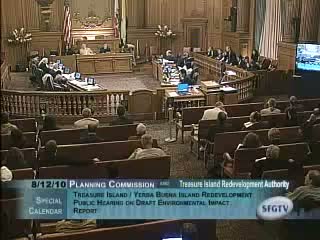
SAN FRANCISCO — The San Francisco Planning Commission and a jointly convened board took public testimony on the draft environmental impact report (EIR) for the Treasure Island–Yerba Buena Island redevelopment project and agreed to extend the written comment deadline after a steady stream of concerns from residents, environmental groups and labor.
Planning Department staff opened the hearing by summarizing the project described in the draft EIR: redevelopment after transfer from the Navy that could yield up to 8,000 housing units, about 140,000 square feet of retail and commercial space, roughly 100,000 square feet of office, adaptive reuse of historic buildings totaling about 311,000 square feet, about 500 hotel rooms and roughly 300 acres of parks and open space, along with a ferry terminal and a new transit hub. Staff emphasized the hearing was for public comment on the draft EIR; responses to testimony will be made in the written comments‑and‑responses document.
Speakers at the hearing urged the commission to require additional analysis or more public review time. Bernard Shoden raised legal‑title questions tied to historic tidelands and warned that unresolved title issues would undercut proposed mitigation. "Clearing that title is foremost," Shoden said, and also pressed the need for thorough geotechnical testing because of liquefaction risk in a major earthquake.
Environmental and conservation organizations urged greater scrutiny of habitat, climate and transportation effects. Mike Lines, conservation director of the Golden Gate Audubon Society, warned that bird and habitat impacts "may suffer" under the proposed mitigations and urged an adequate EIR. Kate Kelley, chapter director of the Sierra Club, and Holly Burke of the local Sierra Club chapter asked the commission to extend the public comment period by two weeks, saying the document is long and many organizations rely on volunteers for review. "It's a very long and complicated document," Kelley said, and ‘‘we respectfully request a 2 week extension on the public comment period." Several other speakers and local resident groups echoed that request.
Residents and community representatives raised questions about relocation, community services and whether existing residents would be able to return. Sherry Williams, executive director of the Treasure Island homeless development initiative (identified in testimony as "tie dye"), said the EIR identifies space for community services but stressed "none of our existing residents will be displaced" and said replacement housing opportunities must be guaranteed. Rosie Masters, a Yerba Buena Island resident, asked for a specific analysis of relocation costs and whether rates would be affordable for current residents.
Several expert commenters pressed technical concerns. Nick Rossi, appearing as co‑counsel for local clients, said the hydrology and water quality analysis did not adequately address the long‑term maintenance of perimeter berms and questioned the sea‑level rise allowances the EIR uses for tsunami design. Tony Gantner and others pointed to the island's history of soil liquefaction and urged caution regarding tall towers and geotechnical feasibility.
Labor and local industry offered support for the project's potential jobs. Manuel Flores of Carpenters Local 22 said the union supports the redevelopment and noted ongoing training programs on the island. Richard Weller of Pile Drivers Local 34 emphasized construction‑related job benefits.
After public comment closed, multiple commissioners and board members said they supported a modest extension of the comment period to allow detailed reviews by community groups and agencies. Commissioner Catherine Moore and others said the EIR should more clearly include or describe the CEQA‑required environmentally superior alternative and additional transit and emergency‑service mitigation details. Commissioner Michael Antonini and Board member comments emphasized tidelands trust issues and recreational‑use discretion as important legal and policy questions.
A motion to extend the public comment period by two weeks was made on the floor. After calendar review the chair set the new written comment deadline as Sept. 10 (close of business). The hearing concluded with the chair asking the public to submit written comments to the Planning Department for inclusion in the formal comment‑and‑response record.
What comes next: the Planning Department will accept written comments through the revised deadline and will issue a written responses document that incorporates public and agency input and any required revisions to the draft EIR. The record will show the public testimony and the department's written responses before any decision on approvals is considered.