Get Full Government Meeting Transcripts, Videos, & Alerts Forever!
Get email alerts on the Environment And Health topic
No spam. Unsubscribe anytime.
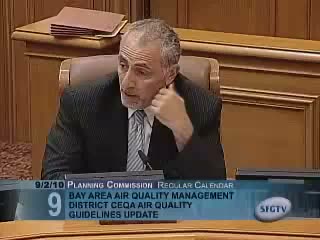
Planning staff outlines Bay Area community risk‑reduction plan; commissioners press on greenhouse‑gas accounting
Summary
Planning staff told the San Francisco Planning Commission that no Bay Area city has yet produced a community risk‑reduction plan and described a citywide, programmatic approach to avoid duplicative EIR work; commissioners pressed staff on how air‑district methodology handles infill, commuting emissions and health factors.
Planning staff briefed the San Francisco Planning Commission on an exploratory community risk‑reduction plan and a citywide, programmatic approach to environmental review that staff said would avoid repeating EIR analyses for small infill projects.
A planning staff member told commissioners, “Nobody's done this community risk reduction plan, so we don't even know what it might look like,” and said the city is trying to develop a methodology over the coming months to avoid requiring new, project‑level EIRs where neighborhood plans have already done the environmental work.
Commissioner Antonini asked whether the Bay Area guidelines and the air‑district methodology account for the greenhouse‑gas and commute impacts that could result if housing is pushed to more distant locations. Antonini warned that moving infill housing away from San Francisco could add commuting emissions that undermine the environmental benefits of infill.
Bill Weico, planning staff, said major EIRs presented to the commission have been run under both the “old” and the “new” standards and that the air district’s current methodology may not reflect the full benefits of infill development. He noted technical problems in air‑district databases — for example, generators reported at maximum authorized use — that can overstate emissions, and said the city is working with public‑health staff to develop local, citywide modeling to better capture sources and impacts.
Staff emphasized that the effort is not merely analytical: it is intended to produce measures that protect people’s health. Commissioners also raised questions about electrifying transit fleets and the health‑risk factors that should be included in modeling. Staff said it continues to meet with the Department of Public Health and other stakeholders as it refines the plan.
The item was informational; no action was required at this meeting. Staff said it will return with more detailed materials and that commissioners requesting additional maps and drafts would receive them in forthcoming packets.