Get Full Government Meeting Transcripts, Videos, & Alerts Forever!
Get email alerts on the Telecom topic
No spam. Unsubscribe anytime.
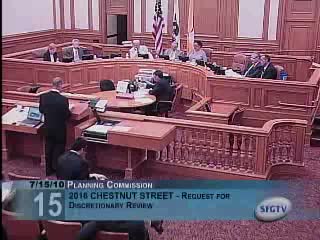
After heated hearing, Planning Commission approves T‑Mobile antennas at 2010/2016 Chestnut Street
Summary
The commission voted to deny a discretionary review and to approve an accessory‑use permit for two T‑Mobile rooftop omnidirectional antennas at 2016/2010 Chestnut Street, despite neighborhood opposition citing safety, property‑value and necessity concerns. The vote passed with several no votes but a majority in favor.
After an extended and contentious public hearing, the San Francisco Planning Commission voted July 15 to deny a discretionary review request and to approve an accessory‑use permit allowing two small cylindrical (about 24‑inch) omnidirectional antennas for T‑Mobile at a mixed‑use building on Chestnut Street.
T‑Mobile representatives told the commission the proposed microcell antennas will fill localized gaps in indoor coverage and improve 2G/3G voice and data reliability. "This site is necessary to allow T‑Mobile to increase the quality of coverage and services it offers to the level customers demand," said Joe Camisha, speaking for T‑Mobile, citing drive‑test data and customer complaints.
Neighbors and resident petitioners challenged the application, arguing the installation is neither necessary nor appropriate for a residential building and alleging the carrier failed to provide an alternative‑site analysis for a Preference‑5 location. Evan Friel and Chris Houston, among others, submitted field tests they said show adequate coverage and raised concerns about battery hazards, maintenance‑related fire risk and impacts on tenants. "The planning commission retains broad discretion to deny a permit in this situation," a Doctor (discretionary review) applicant said.
T‑Mobile’s counsel and RF engineer said the company followed accessory‑use and public‑notification processes, that no backup batteries would be installed at the site, and that drive‑test and propagation data show a coverage shortfall in parts of the Marina corridor and Chestnut corridor. Planning staff confirmed the accessory‑use determination and emphasized that the matter before the commission was whether an extraordinary circumstance existed to warrant discretionary review.
Commissioners split on the public‑safety and precedence questions but several noted that the accessory‑use procedure and prior zoning administrator determinations have been used in similar cases. Commissioner Antonini moved to not take discretionary review and approve the project; the motion passed with recorded votes: Antonini aye, Lee aye, Moore no, Sugaya aye, Alegi no, President Miguel aye. The commission included standard conditions (e.g., post‑installation RF measurements upon request and standard abandonment clauses).