Get Full Government Meeting Transcripts, Videos, & Alerts Forever!
Get email alerts on the Land Use Larkin topic
No spam. Unsubscribe anytime.
Planning commission declines to certify Larkin Street housing EIR after neighbors press reuse, design concerns
Summary
The Planning Commission voted 4–3 not to certify the final EIR for the proposed 27‑unit development at 1601–1603 Larkin Street after residents and preservationists said the document failed to analyze feasible adaptive‑reuse alternatives and adequately address visual impacts. The developer may revise environmental review or the commission may later disapprove the project.
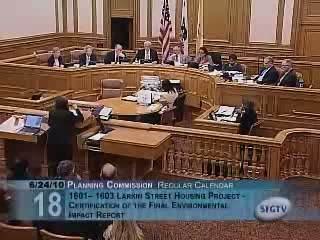
The San Francisco Planning Commission failed to certify the final environmental impact report for the proposed residential redevelopment of 1601–1603 Larkin Street on Thursday, after more than three hours of public testimony and debate.
Planning staff urged certification of the EIR, saying the document complied with CEQA and responded to submitted comments, but neighbors, preservation consultants and some commissioners said the report did not give sufficiently robust treatment to adaptive‑reuse alternatives or to the project’s visual and neighborhood compatibility impacts. "The alternatives in the DEIR are insufficient as proposed," said Joe Butler, representing Friends of Saint John’s First United Methodist Church. "The EIR should contain meaningful, viable reuse options before it is certified."
Project counsel and the sponsor said the church owner has the legal right to demolish the building, and that the proposed new development would bring housing, jobs and tax revenue to the city. "Denying certification of the EIR today will condemn a blighted parcel to remain vacant and hazardous," counsel David Silverman said. The sponsor also submitted a sequence statement listing community and fiscal benefits it argued outweighed identified impacts.
Commissioners were split over whether the document was legally adequate. After extended discussion they voted 3–4 against certification. Commissioners in the minority said they believed the planning department had produced an adequate analysis; commissioners in the majority said outstanding questions about whether the EIR fully considered feasible preservation or partial‑preservation options and about aesthetic thresholds justified withholding certification.
The commission now has three basic paths under state law: it may continue the hearing and ask staff and the sponsor to supply additional analysis; it may disapprove the project (a vote that would render CEQA inapplicable for that disapproval); or it may later hear and decide project entitlements if a revised, certifiable environmental review is filed. Several commissioners urged the sponsor and neighbors to keep talking and to pursue focused additions to the environmental record rather than relitigate the full document. The sponsor said it intends to consider its options.
What’s next: the EIR remains uncertified. The commission’s action means the project cannot be approved as presented until environmental review is resolved; the sponsor may return with a revised EIR or a refined project.