Get Full Government Meeting Transcripts, Videos, & Alerts Forever!
Get email alerts on the Mobile Food Permit topic
No spam. Unsubscribe anytime.
Board upholds DPW mobile‑food permit for Taste of Chicago near Foodsco after dispute
Summary
The Board of Appeals upheld a Department of Public Works permit allowing a Taste of Chicago mobile food truck at 345 Williams Ave., rejecting Foodsco's challenge about pedestrian obstruction and 'like foods' competition but asking DPW to work with the permit holder on alternative locations for additional days.
Foodsco, which operates a long‑running grocery at 345 Williams Ave., appealed a DPW permit for a Taste of Chicago food truck to operate at a parking‑lot entrance the grocery said is a safety and competition risk. Foodsco lawyers and managers said a truck parked at the requested slot would obstruct the store entrance, create queuing on the sidewalk and sell like foods within the 300‑foot radius that DPW uses to limit competition; they asked the board to overturn the permit or impose clear conditions including relocation and a prohibition on "like foods" (SEG 2320–2380; SEG 2414–2421).
Applicant Lamarck McCullough said his operation sells prepared foods (hot sandwiches and pizza) that are not identical to Foodsco’s primarily grocery offerings and that DPW had appropriately conditioned operations to protect pedestrian travel and queuing.
DPW staff described a June 2013 Board of Supervisors ordinance that tightened mobile‑food siting rules and limits how many days a truck may serve a single site; DPW said that because the ordinance became effective July 20, 2013, the department had to apply new limits and conditions to permits issued on or after July 1 (SEG 2718–2726). DPW also explained that the permit included queueing and access conditions to preserve a 6‑foot pedestrian path and to avoid blocking the driveway.
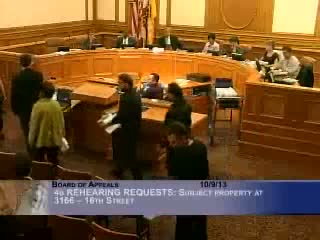
After deliberation — including concerns about safety, the definition of "like foods" and the retroactive effect of the new ordinance — the board voted 5–0 to uphold the DPW permit as issued and asked DPW to expedite any subsequent modification application and to help the permit holder find a nearby second location for additional operating days, and to waive whatever fees DPW can in that context (board action recorded Oct. 9).