Get Full Government Meeting Transcripts, Videos, & Alerts Forever!
Get email alerts on the Formula Retail topic
No spam. Unsubscribe anytime.
Board splits on Jack Spade permits; revocation motion fails to reach threshold so permits stand
Summary
A divided Board of Appeals debated whether Jack Spade should be treated as "formula retail" tied to Kate Spade and subject to a conditional‑use hearing. The board voted 3–2 to revoke permits, but under the City Charter four votes are required to overturn departmental action, so the permits remain in effect.
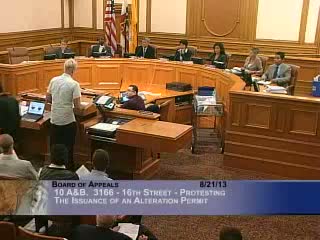
The San Francisco Board of Appeals spent much of its Aug. 21 meeting debating whether Jack Spade, a men’s retail brand affiliated with Kate Spade, should be counted as formula retail under Planning Code Section 703.3 and therefore subjected to a conditional‑use hearing.
Opponents, led by the Valencia Corridor Merchants Association, urged the board to treat Jack Spade and Kate Spade as a single retail enterprise, arguing they share trademarks, common branding cues and corporate control and that public comments and city findings support requiring a public conditional‑use hearing. Jefferson McCarley of the association said the law’s purpose is to protect neighborhood retail character and allow community review when larger corporate entrants plan to open in commercial corridors. “Prop G intended that big enterprises go through a conditional‑use hearing,” he told commissioners.
Jack Spade’s representatives, including Philip Lesser and Melissa Exitis, countered that Jack Spade stores are separately branded, have distinct interiors and merchandising, and that under current code the store count threshold must be met before the enumerated features are considered. Planning staff told the board that, at the time of the hearing, Jack Spade had 10 U.S. locations; adding the proposed Sixteenth Street store would bring the brand to 11 only for Jack Spade itself. Planning’s Scott Sanchez noted that separate trademarks and the statutory sequence matter under Section 703.3: the code starts with a numeric threshold and then asks whether two or more listed features exist.
After hours of testimony from neighborhood merchants, community groups and small‑business owners on both sides, the board voted 3–2 to revoke the Jack Spade permits on the grounds of likely negative effect on surrounding businesses and the community. President (as named in the transcript) moved to grant the appeals; Commissioners Hurtado and Honda voted with the president, while Commissioners Fung and Lazarus dissented. Under City Charter Section 4.106, however, overturning the Department’s over‑the‑counter issuance of these tenant‑improvement permits requires four votes. Because the motion to revoke received only three votes, the departmental permits were preserved by law and the store may proceed unless the Department or another body takes additional action.
The dispute highlights a gap in the current code identified by speakers and staff: corporate ownership, related trademarks and closely aligned merchandising can raise community concerns even when a given storefront does not technically cross the statutory threshold. Several speakers — from neighborhood merchants such as Adobe Books and Bell Jar to Mission community organizations — urged the board to favor a public conditional‑use review to allow neighbors to weigh commercial, cultural and displacement risks. Store supporters, representing current Sixteenth‑Street merchants and the applicant, said Jack Spade would invest in a neglected block, reemploy local contractors and add foot traffic that helps nearby independent businesses.
Next steps are procedural: the permits remain in effect because the Board lacked the four votes needed to overturn issuance. Community groups and the Board of Supervisors’ offices have active legislative proposals seeking to clarify whether corporate affiliation or national‑brand family ownership should count toward the formula retail threshold; those proposals were referenced repeatedly during the hearing but are separate from the Board’s action.
The Board recorded that the matter drew broad public participation, with lengthy testimony pro and con, and left unresolved the policy tension between strict textual application of the code and the voters’ and neighborhoods’ concerns about the effect of national or regional brands on local commercial character.