Get Full Government Meeting Transcripts, Videos, & Alerts Forever!
Get email alerts on the Taxi Medallion Mou topic
No spam. Unsubscribe anytime.
Board balks at SFMTA proposal to limit de novo review in taxi medallion appeals
Summary
SFMTA proposed an MOU to limit de novo hearings in medallion revocation and denial appeals so the Board would consider agency and hearing-officer records; commissioners and public raised concerns about stripping long-standing review rights and access for low-income permit holders. No adoption vote was taken.
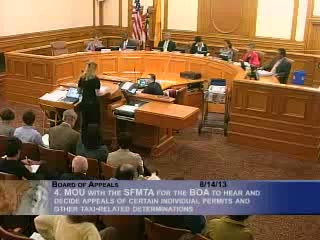
The San Francisco Board of Appeals heard a presentation Aug. 14 from the San Francisco Municipal Transportation Agency asking the board to enter a memorandum of understanding under which the agency’s investigatory and hearing-officer records would form the primary basis for the board’s review of medallion-permit revocations and denials.
Christian Hayashi, deputy director for taxis and accessible services at SFMTA, told the board the proposed arrangement responds to the factual complexity of revocation cases — records covering several years of trip sheets and airport records — and aims to avoid deciding a years-long enforcement matter in a short hearing slot. Hayashi described revocation outcomes as significant for drivers and the agency and said the MOU includes a remand procedure when genuinely new evidence emerges.
Commissioners pushed back on a change Hayashi described that would limit the board’s traditional de novo review and instead constrain appeals to the administrative record or a narrow “abuse of discretion” standard. Commissioner Frank Fung said the change would “alter the way the standard that we used to have, which is the de novo review,” and that it risked preventing the board from considering new facts in cases that took years for staff to develop. Hayashi replied that the intent was not to deny genuinely new evidence and that remand would address such situations.
Several public commenters — including cab drivers and small-business advocates — urged the board not to cede long-standing rights. Tara Hausman told the board the MOU “is taking away the rights from a group of people who cannot afford to immediately go to appeals court,” and said paragraphs of the draft would bar de novo hearings and effectively prevent members of the public from introducing evidence. Others warned that narrowing the standard could disadvantage disabled drivers or medallion owners who lack counsel.
Commissioners said they were sympathetic to SFMTA’s concern about the complexity of revocation cases but repeatedly expressed reluctance to accept the current draft. Multiple commissioners said the board’s value lies in providing a citizen review and urged preserving the ability to hear new facts. No motion to adopt the MOU was made at the meeting; commissioners indicated they were not inclined to approve the draft as written.
Next steps: The board did not adopt the MOU and left the matter open to further negotiation and possible revision. SFMTA staff indicated the remand provision is intended to allow new evidence to be considered, while commissioners requested clearer language preserving the board’s role as a citizen review body.