Get Full Government Meeting Transcripts, Videos, & Alerts Forever!
Get email alerts on the Hunters Point Shipyard topic
No spam. Unsubscribe anytime.
City team outlines Hunters Point Shipyard redevelopment, cleanup status and transportation plans amid mixed public reaction
Summary
City officials presented the DDA, financing and cleanup status for the Candlestick Point–Hunters Point Shipyard redevelopment, saying the site is well‑characterized and many parcels have been cleaned; residents and advocacy groups raised disputed claims about radiological risks, parcel E2 and monitoring practices.
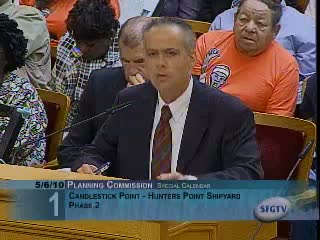
Michael Cohen, representing the mayor’s office and the redevelopment team, told the Planning Commission on May 11 that the Candlestick Point–Hunters Point Shipyard project is a public‑private partnership governed by a disposition and development agreement (DDA) that links financing, transportation, parks and affordable housing. He said the city is using phasing, financial guarantees and a right of reverter to protect public benefits and that Alice Griffith public housing will be rebuilt in the first subphase.
The city emphasized the DDA’s role in enforcing timing and public benefits. Cohen said financing for horizontal infrastructure and public amenities is roughly $2 billion and will be paid through private capital, Mello‑Roos Community Facilities District borrowing and tax‑increment financing tied to the redevelopment plan. He added that the city bears no downside risk if projections fail, because the financing structure and contractual protections place remediation and major cleanup obligations with the Navy under base‑closure law (BRAC) and a 2004 conveyance agreement.
Why it matters: The project covers multiple city goals—affordable housing, parks, jobs and open space—but rests on complex cleanup, regulatory concurrence and large public‑ and private‑sector finances. Commission members pressed staff on transportation phasing, stadium triggers and interim transit capacity.
On cleanup, Amy Brownell of the San Francisco Department of Public Health described excavation and groundwater treatments conducted by the Navy and regulated by multiple agencies. She outlined the Navy’s remediation methods—soil excavation, groundwater bioremediation (injecting amendments to encourage bacteria that degrade contaminants), and removal of sewer systems—with routine air monitoring and regulatory QA/QC. Cohen and staff said regulators have taken thousands of samples over two decades (the record cited tens of thousands of soil and groundwater samples) and that EPA, the state Department of Toxic Substances Control, the California Department of Public Health and regional water boards all participate in oversight.
Community reaction split sharply. Public testimony ranged from support for cleanup, jobs and housing to sharply worded charges that monitoring has been inadequate and that radiological and other contamination remain under‑addressed. Speakers representing neighborhood groups and environmental organizations urged removal for certain landfills (Parcel E2), independent peer review of data and direct testimony from Navy representatives. Other residents, unions and community groups said redevelopment would bring jobs, workforce investment and legally binding community benefits; the Labor Council highlighted an agreement it said would guarantee 32% affordable housing and $17 million for workforce development.
Transportation and the Yosemite Slough corridor were focal points in the city’s plan. Peter Albert of MTA outlined a multimodal transit strategy centered on bus rapid transit (BRT) and express links to regional systems (BART and Caltrain), with proposed local route extensions and two new express lines. Albert also showed design concepts for the Yosemite Slough bridge, which the city says would serve buses, bikes and pedestrians most days and carry limited automobile lanes for game‑day egress under a stadium scenario. Environmental groups and some residents opposed the bridge on wetland and habitat grounds and questioned its cost and necessity.
What comes next: Staff said the transportation elements are being analyzed in the project EIR; the Commission asked for more composite maps showing existing conditions and proposed changes. Project staff and regulators said transfers of some parcels are slated for the coming spring subject to regulatory concurrence. The Commission closed public comment and signaled further hearings and EIR review ahead.
Ending: The presentation left key outstanding issues for later review: the draft EIR’s technical appendices, independent scientist briefings requested by critics, and the Commission’s negotiated terms in the DDA that would lock in tenant protections and enforcement mechanisms.