Get Full Government Meeting Transcripts, Videos, & Alerts Forever!
Get email alerts on the Land Use Museum Shadow topic
No spam. Unsubscribe anytime.
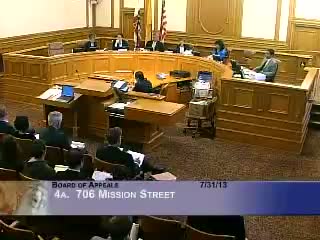
Board of Appeals upholds Planning Commission on 706 Mission Mexican Museum project
Summary
The San Francisco Board of Appeals on July 31 denied appeals and a jurisdiction request challenging the Planning Commission’s Section 309 determination for the 706 Mission Street Mexican Museum and 480‑foot residential tower, finding no error in interpretation or abuse of discretion and sustaining CEQA findings.
The San Francisco Board of Appeals denied an appeal and a related jurisdiction request on July 31, 2013, clearing the way for the proposed Mexican Museum and adjacent 480‑foot, 43‑story tower at 706 Mission Street to proceed under approvals already granted by city decision‑makers.
Appellants represented by attorney Tom Lippy argued that the Planning Commission improperly increased a shadow “budget” for Union Square under Planning Code Section 2.95 and that the commission’s findings were unsupported by the evidence. Lippy told the board the Planning Commission’s shadow calculations were “not enforceable” and said the finding that the project would have no significant effect lacked the analytic route required under CEQA.
Project counsel Margot Bridal and Planning Department staff defended the approvals. Bridal said every city body that considered the project had approved it and urged the board to deny the appeal. Planning staff explained the Prop K and Section 2.95 framework and described the qualitative and quantitative criteria used to evaluate shadow impacts.
Several community speakers and cultural‑sector advocates addressed the board in support of the museum, saying the project is the product of decades of planning and public benefit negotiations. Project representatives stressed the negotiated public benefits package, which the project sponsor said would include up to $120 million in public benefits, a $5 million operating endowment for the museum and a 28 percent affordable‑housing component of the residential units.
After questions of counsel and staff and a period of deliberation, the board found no misinterpretation of the Planning Code or abuse of discretion by the Planning Commission and adopted CEQA findings read into the record. Commissioner Fung moved to deny the appeal and to uphold the Section 309 determination; the motion passed by a 4–0 roll‑call vote.
The Board’s action leaves intact the Planning Commission’s determinations; future steps for the project will follow the existing approvals and permit processes already in place.