Get Full Government Meeting Transcripts, Videos, & Alerts Forever!
Get email alerts on the Telecommunications topic
No spam. Unsubscribe anytime.
Planning Commission approves T‑Mobile antennas on 135 Mississippi with conditions
Summary
The Planning Commission voted unanimously to grant conditional use authorization for a wireless transmission facility (four panel antennas) at 135 Mississippi Street after technical review by Hammett & Edison and a lengthy public comment period citing health and notification concerns.
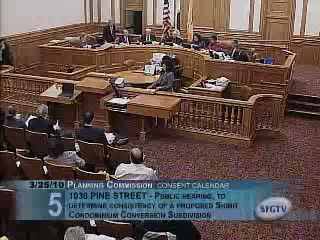
The San Francisco Planning Commission approved a conditional use authorization on March 25 to allow a wireless transmission facility consisting of four panel antennas on the elevator penthouse at 135 Mississippi Street. Planning Department staff said the proposal complies with the planning code and the city—s Wireless Telecommunications Siting guidelines and recommended approval with conditions.
Diego Sanchez of the Planning Department summarized staff findings and noted the site—s designation as a referred industrial/commercial site in the UMU zoning district. Joseph Camisha, representing T‑Mobile, said the location addresses a verified coverage gap and that the carrier followed neighborhood-notice rules and held a community meeting on Dec. 9, 2009. He told commissioners that an exposure study by Hammett & Edison showed predicted levels were under 1% of the FCC public exposure limit and that the San Francisco Department of Public Health had reviewed the proposal.
Dozens of neighbors and local activists testified in opposition, citing health concerns, alleged notification errors and the concentration of antennas. Espinosa Jackson, David Boyd and other speakers urged the commission to follow the Board of Supervisors— recent advisory action asking federal agencies to study health impacts and to map existing sites citywide. Sudie Skoll described herself as electromagnetically sensitive and urged denial; others requested a moratorium until further study.
Commissioners questioned Hammett and Planning and Health Department staff about cumulative exposure, the inverse‑square drop in field intensity, comparisons with in‑home wireless LANs and monitoring procedures. Hammett said measurements are taken as cumulative readings and that the proposed installation would be thousands of times below the FCC limit in typical scenarios; he and staff described post‑installation cumulative measurements and a 10‑day verification plan as conditions of approval.
After hearing staff, the applicant and public testimony, the commission voted unanimously to approve the conditional use authorization with the announced conditions, including post‑activation cumulative measurements and adherence to the planning code and WTS facility siting guidelines. The approval includes monitoring and enforcement provisions the commission requested.