Get Full Government Meeting Transcripts, Videos, & Alerts Forever!
Get email alerts on the Environmental Review topic
No spam. Unsubscribe anytime.
Planning commission certifies final EIR for 555 Washington after fierce debate; vote 4–3
Summary
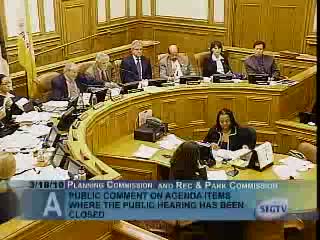
The San Francisco Planning Commission on March 18 certified the final environmental impact report for the proposed 555 Washington Street development over the objections of three commissioners and many public commenters, after extended testimony about tree protection, bird collisions and park shadows.
The San Francisco Planning Commission voted 4–3 on March 18 to certify the final environmental impact report (EIR) for the proposed 555 Washington Street tower, clearing the way for later entitlement decisions despite objections from community groups and three commissioners. The certification followed hours of public comment and technical testimony about tree risks, bird-strike hazards and shadow effects on nearby parks.
The certification motion, made by Commissioner Antonini, passed with Commissioners Antonini, Borden, Lee and Miguel voting yes and Commissioners Moore, Seguaya and Olague voting no. Opponents argued the EIR still left significant uncertainties about impacts to Redwood Park’s redwood trees, the adequacy of bird-strike mitigation and whether a code-compliant alternative had been properly analyzed. Supporters and project counsel said staff had added clarifying language and mitigation measures in the comments-and-responses record and that the EIR met CEQA requirements.
Why it matters: Certification of the EIR is a CEQA procedural milestone that permits the Planning Commission to consider later approvals tied to the project (zoning variances, street vacations, park dedication). Opponents warned certification now could limit later review of outstanding technical concerns; supporters said delaying certification would needlessly prolong a project the sponsors say will deliver housing, jobs and a publicly maintained park.
During two rounds of questioning, commissioners pressed planning staff and project experts on several technical claims. Commissioner Moore and others raised the EIR’s treatment of redwood-tree impacts from construction and staging and questioned whether proposed tree-protection measures in the draft are enforceable; Commissioner Moore read from the project arborist’s report and urged stronger, enforceable measures. Planning staff and the sponsor’s landscape architect said a detailed, recorded tree-protection specification and on-site arborist monitoring would be required as conditions of approval.
Bird collisions and glass design also drew close scrutiny. The EIR’s comments-and-responses section was amended to recommend glass treatments, deep mullions and non-reflective coatings and to include a voluntary lights-out program for certain uses. Several commissioners and scientists said the suggested measures were improvements but questioned whether they were sufficiently enforceable; project representatives said the revised mitigation language and a condition to review a glass mock-up would be added to the mitigation monitoring program.
Public testimony was extensive and sharply divided. Dozens of residents, neighborhood groups, labor unions and merchants spoke. Critics—neighborhood organizations, tree and urban forestry advocates and preservation groups—said the project would degrade park sunlight and threaten mature redwoods. Supporters—labor groups, neighborhood business associations and some civic organizations—said the project brings a half-acre of new parkland, $12 million toward affordable housing, permanent maintenance funding and job creation.
On alternatives, several commissioners noted the EIR analyzed a code-compliant alternative and other variants; one commissioner moved to adopt the code-compliant alternative as the preferred choice, an amendment that failed. The City Attorney’s Office advised that the Commission may reject alternatives if there are stated economic, legal or social reasons for infeasibility, and that adopting the EIR despite unresolved impacts requires a formal statement of overriding considerations when significant unavoidable impacts remain.
The vote: After a string of failed amendments, the Planning Commission certified the final EIR (roll call recorded at SEG 7019–SEG 7040). The commission’s action was immediately followed by continued joint consideration of shadow and park items with the Recreation and Park Commission.
Next steps: Certification enables the Planning Commission to consider subsequent entitlement actions for the project in later hearings. Opponents signaled intent to continue scrutiny of mitigation language and enforceability; proponents said the revised EIR and recorded conditions will bind the project team and New conditions will be brought forward with future approvals.