Get Full Government Meeting Transcripts, Videos, & Alerts Forever!
Get email alerts on the Masonic Cup topic
No spam. Unsubscribe anytime.
Planning commission approves expanded use for Masonic Center with strict conditions amid neighborhood objections
Summary
The Planning Commission approved a conditional-use permit for the Masonic Center (1111 California St.) allowing interior upgrades, expanded concessions and up to 95 larger events a year, with limits on hours, loading, policing and post‑event cleanup. Neighbors raised traffic, noise and safety concerns during a lengthy hearing.
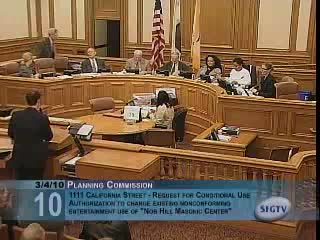
The Planning Commission on March 4 approved a conditional‑use permit allowing the Masonic Center at 1111 California Street to modernize its auditorium, add concession and kitchen facilities and increase event capacity modestly to 3,500 patrons, subject to detailed operating conditions.
The commissionvote followed a long public hearing filled with neighborhood testimony both for and against the proposal. Planning staff recommended approval with multiple mitigation requirements designed to limit noise, control queuing and loading, and address public‑safety concerns.
Why it matters: The Masonic is a city‑scale cultural venue that the commission and staff said needs upgrades to remain competitive and keep events in San Francisco. Opponents said the proposal would intensify late‑night activity in a largely residential, historic part of Nob Hill and raised traffic, parking and emergency‑access concerns.
What the permit does: Staff recommended — and the commission adopted — a package of conditions that include limits on large evening events (a cap on larger daytime events and a cap on large nighttime events, with an allowance for up to five late‑night exceptions per year), mandatory on‑site security and coordination with the Police Department for large events, queuing and crowd‑management plans that keep lines on Masonic property, a requirement that most concession stands stop alcohol service before the event ends, a neighborhood litter‑pickup program after events, and restrictions on overnight truck or bus parking.
Project proponents said the changes would preserve the building nd its cultural uses while reducing neighborhood impacts. Tom Boyer, chief financial officer for the California Masons, said the organization sought a professional manager to ‘‘assure the long term viability of the Masonic Center’’ and that Live Nationwould bring investment and operations expertise.
Live Nationexecutive Matt Kresoff told the commission the operator already limits off‑site parking and agreed to a strict rule: “once the trucks are done unloading, we will send the trucks away to a different location that is not on Nob Hill, only to return at the end of the evening so that we can load the trucks back up.” He said buses and trucks will not remain overnight.
Neighbors contested the traffic and noise analyses and urged denial or delay. Captain Anna Brown of the Central Police District said the department opposed the permit as presented, expressing concerns about congestion, public drunkenness and enforcement; Live Nation and staff said on‑site security and required off‑duty officers for large shows would mitigate those risks.
Outcome and next steps: The commission approved the permit 4–2 with conditions. Staff will report back under the directorreport on progress in neighborhood negotiations and on implementation details; the permit includes ongoing reporting and review provisions. The conditional authorization will be enforced through the permit conditions; failure to comply can trigger enforcement and possible revocation proceedings.