Get Full Government Meeting Transcripts, Videos, & Alerts Forever!
Get email alerts on the Surface Mounted Facility topic
No spam. Unsubscribe anytime.
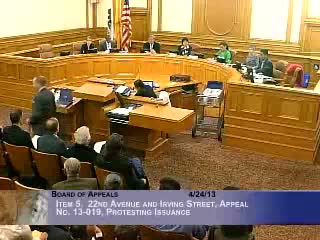
Board upholds AT&T surface-mounted cabinet in Sunset despite notice and safety complaints
Summary
The Board of Appeals upheld the Department of Public Works’ permit for an AT&T surface-mounted facility at 20 Second Avenue and Irving Street after contested testimony about notice, pedestrian impacts and a trip hazard; the decision was upheld by a 3–2 vote with direction for DPW to review alternatives and remedies.
The San Francisco Board of Appeals on April 24 upheld the Department of Public Works’ permit allowing AT&T to place a surface-mounted telecommunications cabinet near 20 Second Avenue and Irving Street, rejecting appellant objections over notice and pedestrian impacts by a 3–2 vote.
Neighbors and the appellant, represented by counsel, argued the cabinet was installed after insufficient notice and in a location that creates a safety and congestion risk outside a busy post office and supermarket. Appellant emphasized door-hanger and direct outreach steps alleged to be missing and urged the board to hold AT&T to its memorandum of understanding commitments. Several neighborhood merchants and residents described difficulty as motorists and bus passengers navigate curbside activity and said the cabinet impedes loading and wheelchair access.
AT&T representatives said they provided multiple forms of notice (mailings, postings within 300 feet, door hangers) and that the site complied with DPW siting guidelines; they offered mitigation including a bond, graffiti removal, and screening. DPW staff outlined the department’s siting rules and said the location met technical requirements; the department explained that posting and mailing practices differ for carts, trucks and SMFs and that they had evaluated alternative placements.
Board discussion centered on (1) whether DPW and AT&T had satisfied notice obligations under the SMF order and the MOU, and (2) whether alternative locations within the required technical radius existed. Commissioners expressed varying comfort with DPW’s reliance on AT&T’s technical submissions and noted the need for clearer, standardized documentation of alternative-site assessments. The motion to uphold DPW’s permit carried on the basis of DPW’s findings (vote recorded 3–2).
What happens next: The permit remains in place; DPW and AT&T said they would pursue finish-work to remedy any lip/trip hazard or remove the cabinet if subsequent review requires it. The Board encouraged DPW to document alternative-site analyses more explicitly going forward.