Get Full Government Meeting Transcripts, Videos, & Alerts Forever!
Get email alerts on the Mobile Food Permit topic
No spam. Unsubscribe anytime.
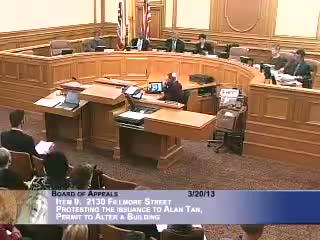
Board of Appeals rejects motion to overturn DPW, mobile espresso permit stands by default
Summary
After public comment about conflicting permit addresses and measurement methods, the Board of Appeals failed to overturn the Department of Public Works— issuance of a mobile-food permit for Espresso Subito (permit 11MFF0167). A motion to overturn failed 2— 3 and, because the charter requires 4 of 5 votes to overturn departmental action, the permit remains upheld by default.
The San Francisco Board of Appeals took up appeal 12-126 on March 20 over a Department of Public Works mobile-food permit for a proposed Espresso Subito espresso cart near 84 Second Street/150 California Street. Appellants and multiple speakers raised technical objections to the permit, centering on inconsistent address references in department files and how DPW draws its 300-foot notice radius.
Members of the public and business owners told the board that DPW records alternately list the truck location as "84 Second Street" and as an offset described as "90 Second Street" ("49 feet northwest of the corner"), producing conflicting measurements that affect whether neighborhood businesses received legally required notice. Charlie Yu, speaking for appellants, asserted DPW had used the midpoint of assessor—s blocks rather than block faces when drawing the notice radius and called the application of the law "arbitrary and capricious." Several neighbors said the truck would block sidewalks and compete with nearby storefronts.
Planning staff clarified that the permit on appeal was a DPW mobile-food permit and that the planning department—s separate change-of-use permit for the tenant was scheduled for a different hearing. Commissioner Arceloria Hurtado, who reviewed past hearings and the record, moved to uphold DPW—s decision, arguing notice issues had been cured and DPW had exercised reasonable discretion.
The roll call (on the motion to uphold DPW) returned Commissioner Fung: No; President Huang: Aye; Vice President Lazarus: No; Commissioner Honda: No. The motion failed 2— 3. Because overturning or modifying a departmental action requires four of five votes under the charter, the board did not reach the threshold to overturn DPW; absent another successful motion, the permit therefore remained upheld by default.
No further motion to overturn the permit was made and the board moved on to the next calendar item. The broader policy arguments about notice methods and how DPW calculates the 300-foot notice radius were highlighted repeatedly by speakers and may be raised again to the Board of Supervisors or in administrative follow-ups.