Get Full Government Meeting Transcripts, Videos, & Alerts Forever!
Get email alerts on the Residential Foundation Permit topic
No spam. Unsubscribe anytime.
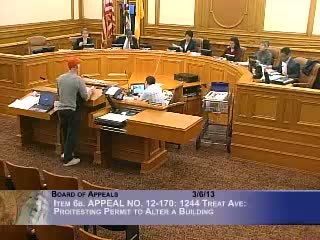
Board denies two neighbor appeals and upholds 1244 Treat Avenue permit after engineering debate
Summary
After testimony from neighbors, engineers and DBI, the Board of Appeals denied two appeals concerning egress, a long-used tenant laundry, and foundation work at 1244 Treat Avenue and upheld the permit 4–0, while noting remaining coordination and construction controls.
The San Francisco Board of Appeals on March 6 denied two appeals to a permit at 1244 Treat Avenue that would replace foundations and alter interior space, upholding the Department of Building Inspection’s decision by a 4–0 vote.
Neighbors Terrence (Terry) Malley and Dong Su raised several objections: Malley said the project would remove a second means of egress and take away a basement laundry he has used for decades; Su and their engineer raised concerns that the building is legally three attached parcels with a shared foundation and that proposed foundation work could destabilize adjoining properties and disrupt shared sewer lines. "We're not granted permission for them to do that," Su said of work on shared foundation elements.
Permit holder Peggy Mango, architect Troy Kishanipur and structural engineers described a revised "compromise" design that preserves much of the existing brick foundation while adding a new adjacent concrete retaining wall designed to carry loads and mitigate overturning and sliding. DBI staff said the building permit had followed their process and that upgraded foundations are often recommended in San Francisco’s seismic zone. A structural engineer for the appellants questioned factor-of-safety calculations and consistency across plans; the permit holder’s engineer replied that the compromise meets the 1.5 factor-of-safety code requirement for overturning and that a slab prevents sliding.
Board members acknowledged neighborhood impacts including construction noise, asbestos/lead abatement and temporary sewer work but said mitigation, monitoring (geotechnical monitoring and pre-construction data points) and DBI oversight are appropriate remedies. Commissioner Tano moved to deny both appeals and uphold the permit as properly issued; the motion passed 4–0. The permit holder committed on the record to notify neighbors, use licensed contractors, and provide monitoring; the board noted that execution of the permit may depend on obtaining access or agreements with neighboring owners where work crosses property lines.