Get Full Government Meeting Transcripts, Videos, & Alerts Forever!
Get email alerts on the Land Use Development topic
No spam. Unsubscribe anytime.
Planning commission declines to certify final EIR for 555 Washington; matter continued after split votes and hours of public comment
Summary
After more than four hours of public testimony for and against the proposed 555 Washington project, San Francisco commissioners voted down a motion to refuse certification but did not complete certification and continued the EIR hearing to March 18. The meeting also recorded a recusal and procedural disputes over CEQA and Prop K.
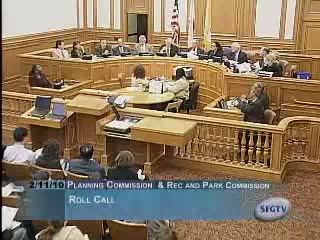
San FranciscoPlanning Commission and the Recreation and Park Commission opened a joint hearing on certification of the final environmental impact report for the proposed 555 Washington Street project and spent several hours hearing public testimony before votes and procedural rulings left the matter unresolved.
Commissioner David Lee presided over a roll call at the start of the session and the commissions first dealt with an early ethics motion: Commissioner Sullivan disclosed that she had joined the Pillsbury Winthrop law firm, which represents the project promoter, and the body voted to excuse her from participating in deliberations and decisions on the project.
After a lengthy procedural exchange about whether the Planning Commission could act on CEQA certification separately from the Recreation and Park Commission, commissioners heard dozens of public speakers who sharply disagreed about whether the final EIR is adequate. Opponents argued the document remains "fundamentally flawed and defective" and cited specific failures on land use, shadowing, wind, cultural resources and transportation. Aaron Peskin told the panel, "I respectfully encourage you not to certify this fundamentally flawed and defective document." Supporters countered that the project would expand a small private park into public open space, deliver roughly $12,000,000 toward affordable housing and produce union jobs and green-building benefits.
Commissioner Seguaya moved that the commission not certify the EIR, laying out a long list of concerns including multiple "variants" in the project description, unquantified shadowing for Redwood Park and what he called inadequate mitigation for tree and bird impacts. Several other commissioners echoed parts of that critique on the record, while other commissioners and staff said the final EIR follows the department's standard protocols and contains quantifications and mitigation commitments.
The motion to not certify failed on a roll-call vote (three in favor, two opposed). With no motion to certify on the table and because the hearing had been set as a joint proceeding that effectively needed further action, staff announced that the item would be continued to March 18, giving the commissions time to resolve outstanding technical and procedural questions and to allow absent commissioners an opportunity to participate. President Miguel closed the session after instructing staff to schedule the continued joint hearing.
What happened next: the commissions recorded formal actions during the session. Commissioners voted to excuse Commissioner Sullivan for conflict reasons; the Planning Commission debated and rejected a blanket continuance; a separate Rec & Park vote continued that commission's items and led to dissolution of the joint session; and finally the Planning Commission put the certification question back to a future date. The public record includes detailed comments from neighborhood groups, labor representatives, environmental advocates and multiple technical consultants that the commissions asked staff to address before the next hearing.
Next steps: The matter is continued to March 18 for reconvened joint hearings and additional technical responses. The continuance preserves all public comments made today "on the record," and staff indicated the transcript and taped testimony would be available to any commissioners who choose to listen rather than attend in person before the continued session.