Get Full Government Meeting Transcripts, Videos, & Alerts Forever!
Get email alerts on the Wireless Telecom topic
No spam. Unsubscribe anytime.
Planning panel approves two wireless antenna installations after health concerns raised
Summary
The Planning Commission approved Verizon panels at 6221 Gary Blvd and MetroPCS facade antennas at 1800 Sutter (Hotel Tomo) with design conditions; nearby residents raised RF health and proximity concerns and staff recorded limited public opposition.
The Planning Commission on Feb. 11 approved two separate conditional‑use/preference‑installation requests to expand wireless coverage with design modifications and conditions following public comment about health and proximity to residences and childcare sites.
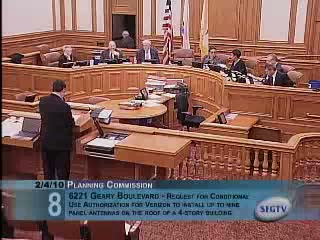
At 6221 Gary Boulevard in the Outer Richmond, planning staff (Jonas Ionian) presented Verizon’s plan to install up to nine antenna panels, most integrated into existing vertical facade elements and several roof‑mounted in faux vent stacks; staff reported one phone call of opposition citing health concerns. Mark Lobaugh of Complete Wireless represented Verizon and said designs sought to minimize visual impact. The commission approved the project with conditions and symmetry requirements for facade build‑out.
At 1800 Sutter Street (Hotel Tomo) in Japantown, staff presented a MetroPCS proposal for facade installations. MetroPCS engineer Joe Salota and representative Ryan Crowley answered questions about siting; nearby residents and parents of a preschool raised concerns about an antenna pointing toward adjacent residential units and a preschool/playground within ~300 feet. MetroPCS said it considered alternate sites such as Hotel Kabuki but did not secure leases; the company agreed to move a west‑facing antenna slightly north to reduce visibility into the nearby building. Commissioners emphasized legal limits on basing decisions on health concerns when radio‑frequency exposure levels are demonstrated to be far below federal limits, and noted one tested installation measured less than 1% of the most restrictive public exposure limit. The commission approved the Sutter Street installation with the design modification to shift the west elevation antenna.