Get Full Government Meeting Transcripts, Videos, & Alerts Forever!
Get email alerts on the Department Budget topic
No spam. Unsubscribe anytime.
Planning department lays out 2010 work program; seeks direction on enforcement and sustainability
Summary
Planning staff presented a proposed FY2010 work program that emphasizes a sustainable development strategy (SB 375/AB 32 alignment), implementation of area plans, a permit‑tracking system and continuing pressures on Historic Preservation and code enforcement budgets; commissioners asked staff to return with options to balance the work plan amid revenue uncertainty.
The San Francisco Planning Department presented its FY2010 work program and budget priorities to the Planning Commission on Jan. 21, highlighting staff proposals to refocus resources on a citywide sustainable development strategy, implement adopted area plans, and continue development of a permit‑tracking system intended to improve public access to case materials and timelines.
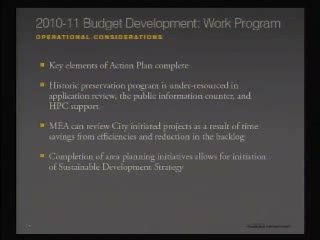
Director's staff emphasized that the proposed work program is not balanced under current revenue projections and offered a set of trade‑off choices for the commission to consider. Key items include:
- Sustainable development strategy: staff proposed a larger focus on citywide sustainability and land‑use strategies to align with state mandates (SB 375 and AB 32) and regional planning work with ABAG/MTC.
- Plan implementation: with several area plans adopted (Eastern Neighborhoods, Market Octavia and others) the department proposed reallocating resources from plan writing and surveys to implementation and capital planning in those plan areas.
- Permit tracking and public information: staff reported that a permit tracking procurement is in late contract negotiations; staff expect to pilot improved public posting of case reports and online materials in the near term and carry implementation costs into the next fiscal cycle.
- Historic preservation and code enforcement: staff warned of funding pressures. Historic Preservation review workload has increased and the department lacks a permanent funding stream for certain survey work; code enforcement remains largely general‑fund supported and faces constraints if general‑fund allocations decline.
Commissioners discussed several follow‑up actions: adding a grant‑writer position (initially funded by a philanthropic partner) to pursue outside grants, examining fee or bond mechanisms (Mello‑Roos/CFD or other seed funds) to front‑fund neighborhood capital planning, and setting a public hearing on budget tradeoffs so the commission can prioritize which programs to preserve.
"We need to figure out how to address the City’s long‑term financing uncertainties," the director told commissioners, adding that staff would return with options for program prioritization and potential revenue solutions.
Staff said they will bring the budget forward to the commission for action in the next scheduled meeting cycle, and will prepare a clearer set of trade‑offs for preservation work, code enforcement staffing, and permit‑tracking implementation costs.