Get Full Government Meeting Transcripts, Videos, & Alerts Forever!
Get email alerts on the Air Quality topic
No spam. Unsubscribe anytime.
Planning staff flags implementation questions as Bay Area Air District updates CEQA air‑quality guidance
Summary
Planning Department staff outlined three major changes proposed by the Bay Area Air Quality Management District: quantified construction emissions, new greenhouse‑gas thresholds, and revised community health‑risk standards. Staff praised the Qualified Climate Action Plan pathway but warned about timing, grandfathering, and calculation details that could affect small projects.
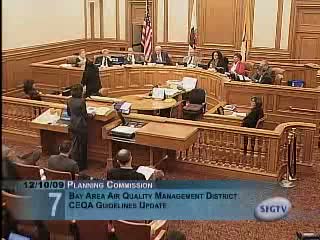
San Francisco Planning Department staff told the Planning Commission on Dec. 10 that the Bay Area Air Quality Management District’s updated CEQA air‑quality guidelines would require projects to quantify construction emissions, set numeric thresholds for greenhouse gases and revise health‑risk thresholds — steps the department said were broadly consistent with local practice but raise implementation questions.
Jessica Range, a Major Environmental Analysis staff member, said the draft guidelines would, for the first time, apply operational‑level thresholds to construction emissions and require projects that exceed those thresholds to adopt additional mitigation or face a finding of significant impact. “Projects will now be required to calculate their emissions from construction,” Range said, noting that could trigger more EIRs for projects that previously qualified for streamlined treatment under best‑management practices.
Range described two parallel paths the district is proposing for greenhouse gases: a quantitative numeric threshold and a qualitative compliance route tied to a Qualified Climate Action Plan. Under the qualitative approach, a jurisdiction that demonstrates consistency with state reduction goals through ordinances, programs and policies could allow projects that conform to that plan to make a less‑than‑significant finding. Planning staff said they helped shape that Qualified Climate Action Plan pathway and welcome it, but remain concerned about how numeric thresholds will be applied to infill and transit‑oriented projects.
The presentation also focused on community health risks, where the Air District proposes both quantitative and qualitative thresholds for toxic air contaminants and fine particulates. Range and staff emphasized that San Francisco already uses a precautionary approach — including Article 38 of the Health Code requiring air‑quality assessments for projects near busy roadways — and urged the district to provide clearer implementation guidance for applying thresholds and preparing community risk‑reduction plans.
David Silverman, a planner in private practice, urged the commission to ask staff for recommendations on grandfathering projects already far along in the entitlement process, warning that applying new construction thresholds without transition rules could force some small residential projects into lengthy EIR reviews at the eleventh hour.
Commissioners welcomed the district’s effort to set clearer regional guidance but repeatedly pressed staff about practical matters — chiefly how the district will set effective dates and whether the quantitative thresholds would discourage infill. Planning staff emphasized that the district’s work remains a draft and that they will continue technical engagement to reduce unintended consequences.
The Air District expected to adopt the guideline update in early January; planning staff said the department had submitted detailed comments and would continue to coordinate with the district as it finalizes methodology and implementation dates.