Get Full Government Meeting Transcripts, Videos, & Alerts Forever!
Get email alerts on the Tupelo Entertainment topic
No spam. Unsubscribe anytime.
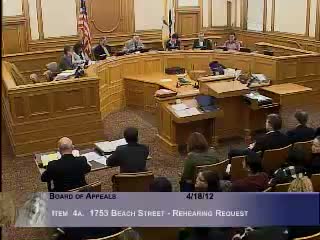
Board upholds zoning administrator's determination in Tupelo entertainment permit dispute; 4-1 vote
Summary
The Board of Appeals upheld the Zoning Administrator's October 2011 letter determining prior planning conditions limit amplified music hours at 1337 Grant Ave. (Tupelo). Board found insufficient evidence that the 2005 Entertainment Commission action superseded a 1997 conditional-use authorization; vote 4-1 to uphold the LOD.
The San Francisco Board of Appeals on April 18 upheld the Zoning Administrator's October 2011 letter of determination (LOD) that the 1997 planning commission conditions of approval continue to limit entertainment at 1337 Grant Avenue, the business operating as Tupelo. The board concluded there was insufficient evidence that the 2005 conditional-use action superseded the 1997 restrictions and recorded a 4-1 vote to uphold the Zoning Administrator.
Tupelo owner and operator Tee Kernan, supported by counsel Mark Rennie, argued that the venue (formerly Mojito) had operated with amplified live music until 2 a.m. under a chain of approvals and that the Entertainment Commission had lawfully issued an entertainment permit allowing evening amplified music. Rennie pointed to planning and Entertainment Commission records he said showed amplified music and the long-running practice of nighttime shows.
Scott Sanchez of the Planning Department told the board the 1997 conditional use authorization (motion no. 14388) contained explicit limits on entertainment: non-amplified live music and restricted hours (weekday 7 p.m.–10 p.m., weekend nights), and those conditions remained on the official record. Sanchez said when Mojito changed ownership and applied in 2005 for a bar (type-47 ABC) the planning department's referral did not alter those original conditions; the Entertainment Commission later issued a permit the Planning Department says did not include the planning conditions.
DBI and Planning staff explained that the current owner could either operate strictly within the 1997 conditions or pursue a planning modification (conditional use authorization) to change hours or amplified-sound rules. The planning department said it had invited Tupelo to file for a conditional-use amendment and noted that no such application had been completed by the parties despite continuances.
Members of the public provided lengthy testimony. Musicians, employees and business advocates told the board that 1337 Grant Avenue has a 40-plus-year history as a live-music venue and urged the board to preserve live entertainment. Police and Central Station officers described policing challenges in the broader Broadway/Grant corridor and provided incident statistics they tied to late-night activity, saying later closure times could exacerbate policing burdens.
After hearing legal argument and public testimony, the board considered whether the Zoning Administrator abused discretion or erred in his interpretation. Commissioners Fung, Huang, Hillis and Hurtado voted to uphold the Zoning Administrator's letter of determination; the motion carried 4-1 (one commissioner dissented). The board's action left in place the Zoning Administrator's interpretation that the 1997 conditions continue to apply and that the appropriate remedy for a business seeking extended hours or amplified sound is to apply for a conditional use authorization to modify the planning conditions.
The board noted the broader policy trade-offs: balancing historic live-music venues and neighborhood quality-of-life and public-safety concerns. It also highlighted planning staff's suggestion that the applicant pursue planning modification to seek longer hours if they wish to change operating conditions.
The board's vote on the appeal does not itself modify the Entertainment Commission permit; it affirms the Zoning Administrator's interpretation and points the parties toward a planning process for any legal change in hours or amplified-music authorization.