Get Full Government Meeting Transcripts, Videos, & Alerts Forever!
Get email alerts on the Fire Safety topic
No spam. Unsubscribe anytime.
Board upholds 1100 Lombard fire‑rated wall permit after hearing CEQA and egress concerns
Summary
After testimony from a fire consultant and neighbors that closing an exterior door could eliminate a needed second exit, the board found the issued 1‑hour fire‑rated wall permit code‑compliant and denied the appeal 4–0 while encouraging parties to coordinate mechanical venting and future variance planning.
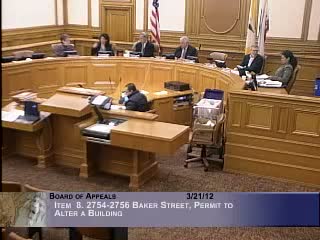
The San Francisco Board of Appeals on March 21 denied an appeal challenging a permit to install a 1‑hour fire‑rated wall at 1100 Lombard Street, finding the permit was code‑compliant after a multi‑part hearing that included CEQA and egress testimony.
Appellants’ counsel Krista Shaw and fire protection consultant Jeff Maddox told the board that closing an exterior door and window at neighboring 2323 Hyde would remove the only west‑side exit from a large house and could undermine required egress for habitable space. Maddox said the building is large enough that “this is over the size that requires two exits by about a factor of 3” and argued that “that second exit is more important than protecting the neighbor from a fire in one building versus the other.”
Permit counsel and the owner argued the wall is needed to support a future expansion and exit configuration and that DBI, planning and fire review had signed off on the scope as filed. DBI and planning staff confirmed this was a phasing decision and that a variance application to provide new rear stairs and eliminate an existing front fire escape was pending. Commissioners examined whether flues/vents and mechanical systems could be accommodated without blocking necessary egress or creating encroachment problems. DBI noted existing administrative equivalencies (AB20) can allow exiting through garage areas in some R‑buildings if properly configured.
After considering the technical testimony and procedural context, the board found no substantive evidence to overturn the permit and denied the appeal 4–0, while noting that mechanical flue relocation and future variance steps should be coordinated between the parties and city departments.
What happens next: The permit stands as issued; parties were urged to coordinate mechanical venting (the flue) and any necessary relocated systems with DBI and planning while pursuing any variance and follow‑up building permits.