Get Full Government Meeting Transcripts, Videos, & Alerts Forever!
Get email alerts on the Wireless Siting topic
No spam. Unsubscribe anytime.
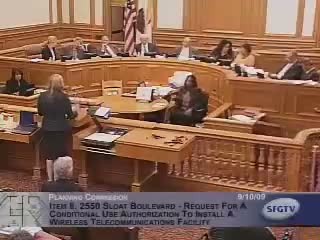
Planning Commission approves AT&T rooftop antennas at 2550 Sloat Boulevard
Summary
The commission approved a conditional use authorization for AT&T to place nine panel antennas disguised as faux chimneys and equipment cabinets at 2550 Sloat Boulevard after staff and the Department of Public Health found RF exposure would be well under FCC limits and the department recommended approval with conditions.
The Planning Commission approved AT&T Mobility’s proposal to install nine panel antennas disguised as faux chimneys on the roof of an existing mixed‑use building at 2550 Sloat Boulevard, along with three equipment cabinets on the garage roof. Elizabeth Waddy of the Planning Department presented the application and told commissioners the Department of Public Health had confirmed the ground‑level RF field would be 3.4 percent of the federal exposure limit and that the project aligns with siting guidelines after an alternative site analysis.
Paul Albritton, outside counsel for AT&T, said the site provides important coverage for the San Francisco Zoo and the surrounding Sunset/Parkside neighborhoods. “This is an essential site for AT&T’s coverage and capacity in the area,” he told the commission; he added that the antennas are designed as neighborhood‑compatible faux vents.
Public comment included neighbors and nonprofit representatives who said improved mobile coverage would aid community safety and outreach (for example, a youth nonprofit speaker said reliable coverage helps staff and students during emergencies). A few residents asked about health and noise concerns; engineers in the applicant team (Bill Hammitt and John Keating) were on hand to explain the RF analysis.
After brief commissioner discussion about visual compatibility and the siting report, Commissioner Borden moved to approve the conditional use authorization; the motion passed unanimously. Staff noted conditions and mitigation listed in the case file would apply. The Department of Public Health memo and the project’s alternative site analysis are in the record.