Get Full Government Meeting Transcripts, Videos, & Alerts Forever!
Get email alerts on the Environmental Review topic
No spam. Unsubscribe anytime.
Commission hears public comment on Exploratorium Pier 15/17 draft EIR; concerns raised about Pier 17 scope, views and birds
Summary
At a public hearing on the Exploratorium relocation draft EIR, staff said Phase 1 (Pier 15) and a potential Phase 2 expansion onto Pier 17 could have significant historic, noise, air‑quality and biological impacts; the commission took public comment through March 16 and closed the hearing pending responses to written and verbal comments.
Planning staff opened a March 5 public hearing to receive comments on the draft environmental impact report (EIR) for the Exploratorium relocation to Piers 15 and 17 on San Francisco’s northeast waterfront.
Staff summarized the project and EIR findings: Phase 1 would relocate the museum to Pier 15, replace the connector building and partially remove paved area between the piers (the valley); the applicant anticipates leasing Pier 17 and potentially expanding there in a future Phase 2. The draft EIR identified potentially significant impacts to historical resources (particularly if Phase 2 proceeds on Pier 17), noise and air quality during construction, and biological resources (including potential pile‑driving effects and impacts on nesting gulls); mitigation measures are proposed to reduce those effects to less‑than‑significant levels.
"The project…is the relocation of the Exploratorium Museum from the Palace of Fine Arts to the San Francisco waterfront, namely Piers 15 And 17," staff told commissioners in the opening presentation. Staff stressed the expanded project for Pier 17 is less developed and that the EIR takes a conservative approach to analyze potential effects.
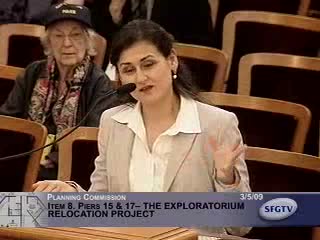
Public testimony came from neighborhood groups, design professionals and waterfront advocates. Supporters said the proposal would rehabilitate deteriorating piers and activate the waterfront. Neighbors and preservation advocates asked for more detailed visuals, questioned the bridge‑building’s materials and massing in the National Register Historic District, and urged further analysis of view corridors. Bird advocates and some residents worried that large expanses of glass—glass bridges and curtain walls discussed in the DEIR—could increase bird collisions; staff said they will consult with biologists and the city’s bird expert in the responses to comments.
Several speakers also requested a fuller analysis of Pier 17 (the expanded project) rather than deferring detailed design and impacts to a future review. Staff reiterated that comments will be transcribed and addressed in a comments‑and‑responses document; the public comment period for the draft EIR runs through 5 p.m. March 16.
The commission closed the hearing on the adequacy of the draft EIR for transmittal to the record and indicated commissioners would comment after the public testimony. Commissioners expressed a range of views: some said view‑corridor impacts are not CEQA thresholds while others urged fuller analysis of Pier 17 and improved graphics to show the project’s visual effects.
Next steps: planning staff will compile written and verbal comments, issue a comments‑and‑responses document and update the EIR analysis as appropriate; separate approvals for project entitlements will follow the environmental review.