Get Full Government Meeting Transcripts, Videos, & Alerts Forever!
Get email alerts on the Affordable Housing Fees topic
No spam. Unsubscribe anytime.
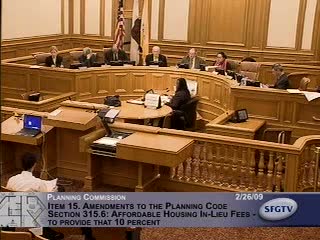
Planning Commission advances amendments to affordable housing in‑lieu fees, urges implementation changes
Summary
The commission recommended changes to Supervisor Daly's draft amendment to planning code §315.6 to allow a portion of in‑lieu fees to be used for small-site acquisition/rehabilitation; commissioners requested implementation language (definitions, triggers, MOH coordination) and removed fixed quotas from final findings before advancing the measure (final vote 5–2).
The commission considered a code amendment (Supervisor Daly) that would amend Planning Code section 315.6 to set aside 10% of in‑lieu affordable housing fees to acquire and rehabilitate small-site housing (projects up to 25 units) and to cap the dedicated fund at $15 million. Tara Sullivan Linne of the Planning Department walked commissioners through revised resolution language and proposed findings, and described concerns raised by the Mayor’s Office of Housing (MOH) about implementation and viability.
Staff proposed alternatives for the commission’s findings: removing rigid numerical requirements in favor of MOH-led implementation; triggering any set-aside only when MOH holds a certain annual threshold of in‑lieu funds; clarifying the definition of “small site” and “rehabilitation”; and allowing funds to be used for owner-occupied as well as rental units.
Commissioner Antonini urged additional guardrails: if the code permits acquisition or rehabilitation, the department should also require that an acquired property be brought to occupancy and that projects not be left dormant. He also proposed allowing project sponsors an option to rehabilitate small sites themselves to meet inclusionary obligations. Several commissioners said they preferred implementation details to be worked out with MOH and the Board of Supervisors rather than locking rigid numbers into the code.
On final action the commission voted to forward the ordinance with modifications and recommended language (removing fixed numerical triggers in findings, clarifying rehabilitation definitions and urging MOH collaboration). The motion passed 5–2 with Commissioners Antonini and Miguel voting no.