Get Full Government Meeting Transcripts, Videos, & Alerts Forever!
Get email alerts on the Housing Element topic
No spam. Unsubscribe anytime.
Planning Department outlines 2009 Housing Element, warns state compliance needed to keep funding
Summary
Planning Department staff told the commission its 2009 Housing Element update—required by the state—focuses on affordable housing, neighborhood character, sustainability and infrastructure and requires community outreach and a full EIR; staff warned that nonconformance could jeopardize state funding for affordable housing and infrastructure.
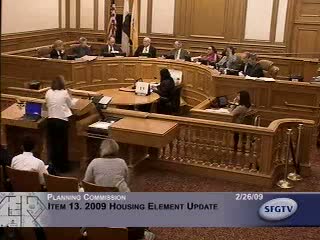
Sarah Dennis Phillips, a Planning Department project lead, briefed the San Francisco Planning Commission on the department’s work updating the 2009 Housing Element, a state-required component of the city’s general plan. The department has pursued a three-part outreach strategy—community advisory body meetings, stakeholder sessions and neighborhood workshops—and is preparing a full environmental impact report for both the 2004 and 2009 elements.
“Our next required update is due June 26, 2009,” Sarah Dennis Phillips told the commission, adding that an element that is not found in conformity with state law can put the city “not eligible for affordable housing funds, infrastructure grants” and other state support. She said staff was working closely with the Mayor’s Office of Housing and Community Development and expects a draft for commission review later this year.
Department materials described four guiding values emerging from advisory sessions: prioritizing affordable housing; preserving neighborhood character; pursuing ecologically and socioeconomically sustainable development; and linking housing to infrastructure such as transit, schools and open space. The department said it had convened a 16-member community advisory body, organized roughly 25–30 neighborhood workshops citywide and met about 200 individuals in targeted stakeholder meetings.
Advisory committee members who addressed the commission praised the department’s outreach but urged sharper focus on implementable programs and stronger, clearer data. Charles Ferguson, representing District 2 on the community advisory body, urged the commission to “identify where we can accomplish [units] quickly” and to track progress toward the roughly 32,000 units the element anticipates during its five-year cycle.
Commissioners pressed staff on several data and implementation issues: how to account for second homes and partially-occupied units that can inflate production figures; whether ABAG and state timelines are being met; and how the element should better connect policy goals to funding and measurable outcomes. Commissioner Moore asked about tracking units used as second homes and suggested partnerships with tax assessor records and census estimates to improve accuracy.
Staff said the department would return with additional data and a more detailed timeline; they also said they expected to complete community workshops through March–May and deliver a draft to the commission for review in the summer months before final adoption later in the year. The commission did not take a formal vote on the housing element at this session.