Get Full Government Meeting Transcripts, Videos, & Alerts Forever!
Get email alerts on the Wildlife Protection topic
No spam. Unsubscribe anytime.
Golden Gate Audubon urges "Lights Out for Birds" voluntary program; commission asks staff to draft supportive resolution
Summary
Golden Gate Audubon presented a voluntary 'Lights Out' program to reduce nighttime building lighting during spring and fall migration to prevent bird collisions. Commissioners favored a short supportive resolution and told staff to bring one back for action.
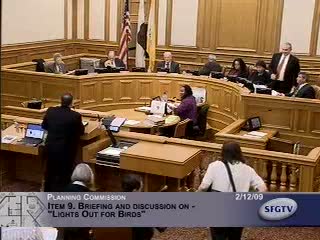
Representatives of Golden Gate Audubon told the Planning Commission on Feb. 12 about a volunteer "Lights Out for Birds" campaign aimed at reducing bird collisions by urging building owners to reduce or turn off nonessential interior and exterior lighting during migration periods. "Last fall, Golden Gate Audubon conducted a volunteer monitoring program, and based on this sample, we're expanding the program to include the 44 tallest buildings in Downtown San Francisco," the group said, urging voluntary sign-ups and offering volunteers to monitor buildings.
Audubon staff described migration windows (spring Feb. 15'May 30; fall Aug. 15'mid-November) and cited work with PG&E, the Department of the Environment and other institutions to receive injured birds and support outreach. Commissioners discussed whether the program should be purely voluntary or whether code language might be appropriate; several members said they supported a short resolution expressing the commission's backing for the voluntary effort.
Commissioner Seguaya offered to draft a short resolution; other commissioners volunteered to help and staff were directed to return with an action item for commission consideration. Commissioners emphasized coordinating with building owners and noting incentives, energy savings and public outreach as part of follow-up work.
Next steps: staff to return with a short resolution and materials to support voluntary participation.