Get Full Government Meeting Transcripts, Videos, & Alerts Forever!
Get email alerts on the Formula Retail topic
No spam. Unsubscribe anytime.
Planning Commission signals intent to deny American Apparel on Valencia Street after hours of public testimony
Summary
After a long, often emotional hearing with hundreds of residents and merchants turning out, the Planning Commission voted a motion of intent to disapprove American Apparel’s conditional-use request for 988 Valencia Street. Commissioners said neighborhood character and commercial diversity weighed heavily in the decision.
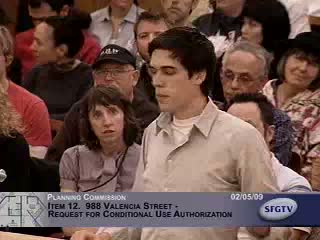
San Francisco — The Planning Commission moved Feb. 5 to signal intent to deny a conditional-use request from American Apparel to open a 2,100-square-foot store at 988 Valencia Street, after about three hours of public comment and testimony from the company.
The application, presented by Ryan Holiday of American Apparel, would have allowed the national retailer to occupy a vacant storefront in the heart of the Valencia Street commercial corridor. Holiday told the commission the company operates in many neighborhoods and describes its stores as “community stores” focused on fair labor and locally relevant merchandising. “We don’t expect the neighborhoods to change for us,” Holiday said. “We were attracted to Valencia because of what it is and what it has been.”
Opponents argued the chain would damage a fragile ecosystem of small, locally owned businesses that sustain the Mission District’s character and economy. “Valencia Street is more than a street — it’s a neighborhood community,” said gallery owner Tom Hines, who said dollars spent at local businesses circulate in the neighborhood. Numerous merchants, arts groups and residents testified that the neighborhood voted strongly for formula-retail limits under Proposition G and that allowing the American Apparel store would raise rents and displace small businesses and arts organizations.
Supporters — including employees, a local merchants association representative and union members — said the company would create jobs with benefits, pay market rent, and offer community donations and partnerships. “We are a California-based company,” said a store manager, asking commissioners to weigh the company’s wage and hiring practices as part of the review.
Commissioners spent substantial time weighing neighborhood testimony and policy. Several members said they supported the conditional-use process in concept but were persuaded by callers and written submissions that the proposed use would significantly change the commercial character of that Valencia corridor. After deliberation, the commission voted a motion of intent to disapprove the application; commissioners recorded ayes on the motion and the item was continued for a final action hearing in two weeks.
The vote does not yet finalize the project fate; the commission will return to the matter at its next meeting for formal action after staff prepares findings. The sponsor may revise outreach and return with additional mitigation measures; several commissioners urged the applicant to continue discussions with merchants and neighborhood groups.
Outcome and next steps: The Planning Commission adopted a motion of intent to disapprove the conditional-use request; the item was scheduled to return for a final vote in two weeks.