Get Full Government Meeting Transcripts, Videos, & Alerts Forever!
Get email alerts on the Land Use topic
No spam. Unsubscribe anytime.
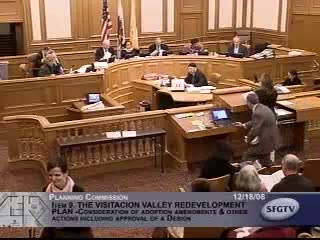
Planning Commission certifies Visitation Valley redevelopment EIR and forwards plan actions
Summary
After years of community work and Planning Department refinements, the Commission certified the final EIR for the Visitation Valley redevelopment program and approved related general-plan, planning-code and zoning amendments, design guidance and cooperation agreements to move the project to the Board of Supervisors and implementation.
The Planning Commission on Dec. 18 certified the final environmental impact report for the Visitation Valley (Schlage Lock) redevelopment plan and approved a package of related actions to allow implementation to proceed.
"This is really the culmination of an eight-year planning project," Planning Department staff said in their presentation. The redevelopment program envisions remediation of contaminated soils, conversion of a vacant industrial parcel into a mixed-use neighborhood with transit-oriented development, up to about 1,600 dwelling units across the program area, and roughly one-quarter of the housing earmarked as affordable with redevelopment-agency participation.
Staff described amendments the Board made after the Commission's earlier review: some height reductions in places, the addition or deletion of special-use overlays in limited locations, adjustments to grandfathering dates for pipeline projects, new monitoring requirements for impact-fee spending, and direction to return to the Commission with implementation proposals and CAC formation. The Commission and staff agreed to technical edits to the redevelopment plan, refinements to the design-for-development document and added provisions to preserve a community-use office building on the site.
Community members and CAC representatives who helped plan the project urged the Commission to approve the EIR and the plan package; business and housing advocates highlighted the project's potential to bring jobs, commercial revitalization and transit-oriented infill housing to the neighborhood. Commissioners praised the depth of community engagement and the attention to contamination remediation and transit connections, and asked staff to track implementation tightly during the interim.
The Commission voted to adopt CEQA findings, forward general-plan and planning-code amendments, adopt the design-for-development with the submitted technical edits, and approve the cooperation and delegation agreement (amended to ensure Commission ratification of any changes to the design-for-development). The Commission directed staff to produce memos and implementation schedules and to work on monitoring and CAC formation in the coming months.
With the Commission—9s actions, the redevelopment package moves to the Board of Supervisors for further action and positions the Redevelopment Agency and Planning Department to begin remediation and early implementation tasks as funding and approvals allow.