Get Full Government Meeting Transcripts, Videos, & Alerts Forever!
Get email alerts on the Water Supply topic
No spam. Unsubscribe anytime.
Planning Commission urges PUC to pursue alternatives to Tuolumne River diversions
Summary
After an SFPUC briefing on conservation and large pipeline projects, the Planning Commission unanimously approved a nonbinding letter asking the PUC to continue seeking water-supply options that reduce withdrawals from the Tuolumne River and to coordinate with Planning on demand studies.
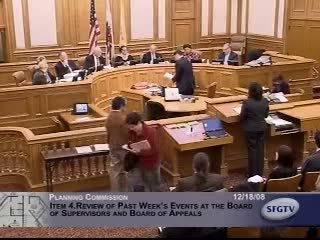
The San Francisco Planning Commission on Dec. 18 heard a detailed presentation from the San Francisco Public Utilities Commission on its conservation program and three major pipeline projects, then authorized Commission President to send a letter urging continued exploration of alternatives to increased diversions from the Tuolumne River.
The PUC told the Commission its conservation plan aims to avoid increasing water taken from the Tuolumne while meeting city and wholesale customer needs through conservation, recycling and groundwater. "After certification of the PUC's Water System Improvement Program programmatic EIR, the SFPUC adopted a water supply program to meet demand through 2018," Ellen Levin, deputy manager of the PUC's Water Enterprise, said in her presentation. The PUC presented rebate and audit programs, a low-income toilet giveaway tied to a state and federal grant of up to $400,000, and per-capita use declines the agency expects to push lower.
PUC project staff outlined three large EIRs soon to come before the Commission: the San Andreas Pipeline No. 3 (a 4.4-mile, 36-inch replacement pipeline), the San Joaquin pipeline system (a 48-mile program to improve Hetch Hetchy conveyance), and the Bay Division Pipeline Reliability Upgrade (a multi-contract program that includes a tunnel under the bay). Staff and PUC presenters emphasized construction-related, mostly temporary impacts—noise, traffic, some tree removal—and the need for multi-agency coordination on rights-of-way and environmental protections.
Commissioners and members of the public pressed the PUC on the timeline and the role of recycled water and demand-side management. The Planning staff had drafted a letter asking the PUC to continue seeking supply options that avoid additional withdrawals from the Tuolumne and to work with Planning on baseline studies and demand analysis ahead of long-range decisions. Public commenters representing the Tuolumne River Trust, Bay Area Water Stewards and regional wholesale customers supported the letter while urging the PUC and the Commission to accelerate studies that compare costs, reliability, greenhouse-gas consequences and other tradeoffs.
The Commission debated adding the word "demand" to the letter but the City Attorney's Office advised that the letter is a nonbinding expression of the Commission's priorities rather than a directive; the office said it would not create a litigation risk. After discussion, the Commission voted to authorize the president to send the staff-drafted letter with the intent described to the PUC and to ask for continued coordination and an annual implementation report.
The Commission also set a schedule for upcoming PUC draft EIR hearings: San Andreas Pipeline No. 3 (draft EIR public review through Jan. 28; Commission hearing Jan. 15), and the San Joaquin and Bay Division Pipeline dockets (draft EIR hearings Jan. 22). The PUC said it will return with additional implementation briefings and welcomed continued engagement with Planning staff and the Commission.
The Commission's letter is advisory. The PUC told the panel that its near-term program emphasizes conservation, recycled water and groundwater as ways to limit increased diversions from the Tuolumne while meeting service-area needs.