Get Full Government Meeting Transcripts, Videos, & Alerts Forever!
Get email alerts on the Medical Cannabis topic
No spam. Unsubscribe anytime.
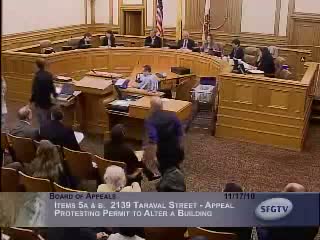
Board of Appeals revokes permit for proposed medical cannabis dispensary at 2139 Taraval Street
Summary
After hours of testimony from neighbors, appellants and the permit sponsor, the San Francisco Board of Appeals voted 4–0 to revoke the building permit for a proposed medical cannabis dispensary at 2139 Taraval Street, citing community concerns and contested application review.
The San Francisco Board of Appeals on Nov. 17, 2010 voted 4–0 to revoke a building permit for a proposed medical cannabis dispensary at 2139 Taraval Street in the Sunset District, reversing a May planning commission approval.
Appellants, including Canaan Tutoring Service and the Chinese Gospel Church, argued the site is within 1,000 feet of multiple youth-serving organizations and therefore falls within the planning code's distance restrictions. Ross Moody, speaking for Canaan Tutoring Service, told the board that “the planning department failed to identify all of the youth serving businesses and entities within a thousand feet,” and that several nearby tutoring centers and a licensed daycare should have blocked the permit.
Russell Davis, attorney for the Chinese Gospel Church, told the board that granting a permit “is simply inconsistent with the message that we tell our kids about drugs,” and urged revocation based on both the text and the spirit of the code. Many neighbors, school representatives and community groups told the board the corridor is heavily used by students and young people and said the location would undermine community planning goals.
Sponsor Greg Shep and counsel defended the application as neighborhood-serving and compliant with applicable definitions and conditions. Shep said the project was intended to “provide safe access for medicine for people in the Sunset District,” and described security plans including cameras and a staffed entrance.
Scott Sanchez of the Planning Department described the application process, the map used to identify allowed locations, and a repeated typographical error in the case report that referenced a non-existent subsection (reported in the planning documents as section 790.50(f)). Sanchez told the board the department treats that reference as a typo and had found the site to be code compliant when evaluated under the proper provisions.
Board members cited two central lines of argument in deliberations: (1) whether the site met the literal code definitions of prohibited adjacent uses and (2) whether the project fit within the planning commission’s discretion given intense neighborhood opposition and documented concerns about the public‑process steps that preceded the commission decision. Commissioners also referenced testimony that translation services at the planning commission hearing had been inadequate for non‑English speakers, which community representatives said limited meaningful participation.
President Tanya Peterson moved to revoke the permit; a roll-call vote recorded four ayes and no nays. The Board announced its decision and indicated written findings would follow.
The permit revocation is the Board’s de novo review result; the decision may be subject to further legal or administrative remedies by the parties. The Board did not impose criminal findings; its action rescinds the planning commission’s approval and the building permit associated with the applicant’s discretionary review.