Get Full Government Meeting Transcripts, Videos, & Alerts Forever!
Get email alerts on the Public Safety And Buildings topic
No spam. Unsubscribe anytime.
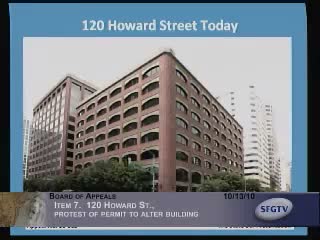
Board continues appeal on 120 Howard vertical addition after technical dispute over seismic analysis
Summary
The Board of Appeals continued the appeal of a vertical-addition permit at 120 Howard St. for one week (to Oct. 20) after the State Bar raised seismic-safety concerns and engineers for the project and DBI disputed the need for further delay; the board allowed limited five-minute presentations per side.
The San Francisco Board of Appeals on Oct. 13 continued for one week its review of an appeal against a proposed four-story vertical addition atop 120 Howard Street after a technical dispute over seismic calculations and peer review. The State Bar, which filed the appeal, urged further independent review of computer modeling and raised concerns about damping factors and 'short-column' (infill) effects in the design; the project sponsor, Shorenstein Company, and its engineers said a lengthy peer-review and DBI plan-check process supports the permit.
Jonathan Kitchen, representing the State Bar, summarized peer-review concerns raised by Professor Jack Maley, an earthquake engineering expert who reviewed computer-model outputs used in the project’s ASCE 41 performance analysis. Kitchen told commissioners that the appellant had only recently been given certain computational results and asked for additional time for independent verification or for the board to impose design conditions such as separating sills from columns.
Shorenstein’s project team (including engineers Joe Maffei, Jim Malley and Ron Hamburger) said the design had undergone multi-year peer review, that they had rerun analyses to address comments and that DBI and independent peer reviewers had found the package acceptable for plan check. Department of Building Inspection staff explained the city's structural-design review process and said DBI requires the engineer of record to demonstrate how peer-review comments were addressed.
Given the technical nature of the dispute and the late submission of some revised analyses, several commissioners supported a short continuance to allow the State Bar limited time to review the newly run numbers. Others said the depth of peer review already performed made further delay unnecessary. The board voted 3-2 to continue the matter to Oct. 20 with five-minute oral presentations allowed for each side and no additional written briefing.