Get Full Government Meeting Transcripts, Videos, & Alerts Forever!
Get email alerts on the Taxi Medallions topic
No spam. Unsubscribe anytime.
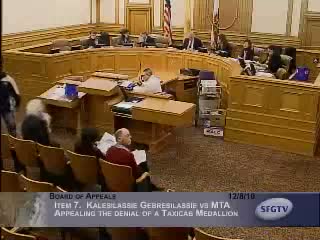
Board of Appeals continues taxi‑medallion appeal to allow waybill review
Summary
The Board of Appeals continued the medallion appeal of applicant Gabor Salassi to March 9, 2011, ordering submission of recent waybills and an MTA analysis after a lengthy hearing over whether he meets full‑time driving requirements.
The San Francisco Board of Appeals on Dec. 8 continued the medallion appeal of taxi driver Gabor Salassi to March 9, 2011, to allow the Municipal Transportation Agency (MTA) time to review additional driving records the applicant may submit.
The MTA said Salassi did not meet the full‑time driving documentation requirements for several disputed years, especially 2005 and 2006, where waybills and gate receipts in the record fell well short of the 800‑hour annual threshold used to demonstrate full‑time driving. Jarvis Murray, enforcement and legal affairs for SFMTA taxi services, told the board that waybills are the determinative records and that the applicant failed to produce adequate waybill documentation for the years in question.
Salassi’s attorney, Ray Alexander, said the case raises a legal question about the interplay of the voter initiative that created the medallion system (Proposition K) and later local regulations requiring multi‑year driving proofs; Alexander and several public witnesses argued Salassi has decades of driving experience and that record‑keeping gaps often stem from cab‑company practices. Multiple drivers and community members testified in support of Salassi, saying they worked with him across many years.
After extended argument and public testimony about missing records, potential company responsibility for lost waybills, and whether tax returns or other corroborating evidence could help, the board voted 3–2 to continue the hearing to March 9, 2011, and allowed a short, five‑page submission by each party. The board directed counsel for the appellant to provide materials three weeks before the hearing and requested the MTA’s written analysis one week before the hearing.
The MTA told the board it will use the submitted waybills to determine whether Salassi can meet the applicable driving standard at the time his application was first considered. Under current rules the department applies a multi‑year hours test; changes to the ordinance and implementation practices were discussed at the hearing but the board’s continuance focused on fact finding rather than resolving that legal dispute.
Next steps: the appellant’s supplemental materials are due Feb. 10, 2011; the MTA’s analysis is due roughly one week before the March 9 hearing. The board did not decide the underlying permit at the Dec. 8 meeting.