Get Full Government Meeting Transcripts, Videos, & Alerts Forever!
Get email alerts on the Noise Permit And Public Health topic
No spam. Unsubscribe anytime.
Tenant and neighbors challenge electrical permit for compressor at 750 Andover; board directs acoustical study and continues case
Summary
Neighbors and a tenant told the board that an electrical permit to hardwire a large air compressor at 750 Andover would breach local noise limits and may require additional building permits. The permit-holder said the unit is for a daytime hobby and plans insulation; the board continued the case to Dec. 15 and ordered acoustical testing and documents.
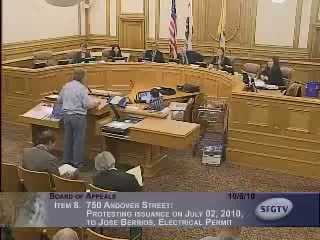
At its Oct. 6 hearing the San Francisco Board of Appeals took up an appeal of an electrical permit issued for a hardwired air compressor at 750 Andover Street, a dispute that raised noise, building-permit and residential-use questions.
Appellant counsel argued the compressor is a commercial-grade machine rated at roughly 84 decibels and, placed directly under a tenant’s bedroom window, would violate the police-code fixed-source noise limits for a residential district (45 dBA at night, 55 dBA daytime). The appellant asked the board to withhold final approval pending an acoustical analysis and resolution of whether a building permit was required for the foundation and anchoring work already performed (SEG 2506-2576).
The property owner and architect said the machine is intended for hobbyist sculpting by tenant Rebecca Blumen, who described limited daytime use and said she is not a commercial sculptor. Architect Alan Toma and owner Jose Barrios said the compressor would be used intermittently and planned enclosure/isolators could reduce the sound. “She plans to do most of this hobby work … during the day,” Toma said, adding that the compressor’s run cycles mean it does not operate continuously.
Lawrence Kornfield of the Department of Building Inspection told the board the electrical permit was issued in response to a complaint about work done without permits and that the department will not sign off on final approval until the outstanding complaint is resolved; he also explained that fixed-source noise regulation and complaint response involves the Department of Public Health and other agencies. Kornfield advised the board that fixed-source noise problems are often expensive and difficult to remediate after installation (SEG 2823-2876).
The board pressed the parties to provide measurements and to clarify whether the installed slab and anchors required a separate building permit. Commissioners suggested the permit-holder obtain an acoustical engineering study, propose an enclosure or alternate location and consider hours-of-operation limits. Several commissioners also noted the challenge of balancing residential needs, legal permits and interdepartmental jurisdiction.
After discussion the board moved to continue the item to Dec. 15 and required the permit holder to file documentation two weeks before the hearing: (1) confirmation of all required permits, (2) an acoustical analysis of ambient and proposed sound levels and proposed mitigation, and (3) any proposed operational-hour limits. The appellant may file a reply one week before the continued hearing. The motion passed 4–0.
Next steps: the permit holder must submit the required acoustical and permitting documentation by the deadlines set by the board; the board will reconvene on Dec. 15 to decide whether the permit may be signed off.