Get Full Government Meeting Transcripts, Videos, & Alerts Forever!
Get email alerts on the Water Infrastructure topic
No spam. Unsubscribe anytime.
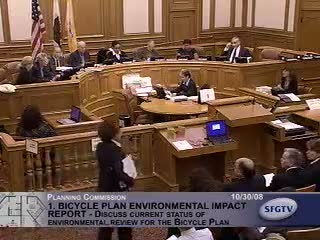
Planning Commission certifies EIR for SFPUC—s Water System Improvement Program amid debate over river diversions
Summary
The San Francisco Planning Commission on Oct. 30, 2008 certified the final program environmental impact report for the San Francisco Public Utilities Commission—s Water System Improvement Program after hours of testimony from students, environmental groups, labor and business leaders over proposed diversions and mitigation. The vote followed questions about monitoring, mitigation triggers and a future 2018 review.
The San Francisco Planning Commission voted Oct. 30 to certify the final program environmental impact report (EIR) for the San Francisco Public Utilities Commission—s Water System Improvement Program (WSIP), clearing the way for project-level environmental reviews and construction of seismic and reliability upgrades.
Ed Harrington, general manager of the San Francisco Public Utilities Commission, described the WSIP as a program of more than 80 projects with an estimated cost of about $4,400,000,000 and said it serves roughly 2,500,000 customers in the Bay Area. "This really is a milestone for our Water System Improvement program," Harrington said in his presentation, adding that the PUC—s staff recommends a phased variant that would cap watershed water sales at roughly 265,000,000 gallons per day through 2018.
The certification motion followed an extended public-comment period in which speakers were sharply divided. Middle-school students from the Nueva School warned that "taking water away would take many things that the river has to offer," and Tuolumne River Trust representatives said they supported seismic upgrades "but are opposed to the diversion of any additional water from the Tuolumne River." Environmental groups including the California Native Plant Society and the Alameda Creek Alliance urged stronger cumulative-impact analysis and more robust mitigation for fish and streamflow impacts.
Business and labor groups urged approval. A number of trade unions and business organizations said delay would raise construction costs and risk public-safety vulnerabilities in an earthquake. Manny Flores of the Northern California Basic Crafts groups read a letter urging certification so seismic retrofits and other work could proceed. Supporters emphasized the program—s job creation and system reliability goals.
Planning staff told commissioners the final PEIR includes a comments-and-responses document and limited errata that do not trigger recirculation under the California Environmental Quality Act (CEQA). Staff said some impacts were identified as significant and unavoidable where mitigation could not reduce effects below CEQA thresholds, and that the PUC would be required to adopt overriding findings where appropriate.
Commissioners asked repeated questions about the difference between a program-level EIR and later project-level EIRs, the basis for the 265 million gallons-per-day cap through 2018, and how the EIR treats a proposed average 2 million gallons per day of additional diversion used for post-drought replenishment. Planning staff and PUC representatives said the program EIR evaluates broad, program-level effects and that most facility projects (about 17 to 20) will require subsequent project-level review and mitigation monitoring; staff also said mitigation measures in the PEIR include triggers that would require additional mitigation on the Lower Tuolumne River if diversions exceed specified thresholds.
After deliberation, Commissioner William Lee moved to certify the EIR; the motion passed on recorded roll call and the commission certified the WSIP program EIR. Commissioners and staff also agreed to calendar a December follow-up item to identify issues the commission wants emphasized in future 2018 reviews, including monitoring, mitigation triggers, and climate-change considerations.
What happens next: certification authorizes the PUC to proceed with project-level environmental review, design and permitting steps specified in the WSIP schedule; the PUC said it expects many project-level EIRs to come before planning over the next 12 to 18 months, with construction projected to finish by about 2014 under the program schedule described to the commission.
Sources: Planning staff presentation; remarks by Ed Harrington, SFPUC; public testimony from Tuolumne River Trust, California Native Plant Society, Alameda Creek Alliance, labor and business groups; commission deliberations and recorded roll-call vote.