Get Full Government Meeting Transcripts, Videos, & Alerts Forever!
Get email alerts on the Renewables And Biofuel topic
No spam. Unsubscribe anytime.
PUC and Port outline solar, desalination and grease-to-biodiesel pilots; shoreside power grant approved
Summary
The Public Utilities Commission and Port described water-conservation measures, a PUC-funded solar incentive, a grease-recycling program feeding biodiesel production, and a $1.9 million grant toward shoreside power for cruise ships at the Port.
At the Planning Commission hearing, the San Francisco Public Utilities Commission and the Port described a suite of operational pilots and capital projects intended to expand renewable energy and resource-recovery in the city.
Laura Spangen of the PUC noted that the city’s municipal power portfolio includes hydro generation at Hetch Hetchy and that the PUC is funding a solar incentive program intended to accelerate rooftop installations. Spangen said the PUC has seen a surge in applications since the incentive launched, and described a publicly accessible solar potential map at sfsolarmap.org to help residents and businesses assess rooftop solar viability. On municipal operations, she said municipal solar projects (Moscone Center and other sites) are underway and that a 5-megawatt reservoir solar allowance now enables crediting generation to other municipal facilities.
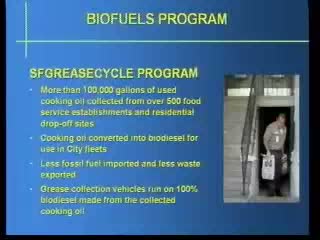
On waste-to-fuel initiatives, Spangen described the Grease Cycle program, through which restaurants collect cooking grease for conversion to biodiesel; she said more than 500 restaurants had signed up and that Darling International is a local partner for biodiesel production. Jay Och and Carol Bach of the Port said the port is working with the PUC to install solar on Pier 96 (estimated 380,000 kWh per year) and to retrofit tenant facilities; the Port also received a $1.9 million grant to build shoreside power that allows cruise ships to plug into shore electricity rather than run diesel auxiliary engines while docked. Jay Och provided quantified emission reductions per ship call (NOx, SOx, particulates and large CO2 reductions) and said shore-power work could be completed by the end of the following year subject to funding and construction schedules.
PUC and Port staff stressed funding partnerships (PUC revenues, state grants and federal pilot programs) and emphasized that many of these projects remain in early implementation phases or pilot stages. Departments told commissioners they would provide future updates and implementation details, including ongoing outreach to restaurants, property owners and tenants.