Get Full Government Meeting Transcripts, Videos, & Alerts Forever!
Get email alerts on the Land Use Development topic
No spam. Unsubscribe anytime.
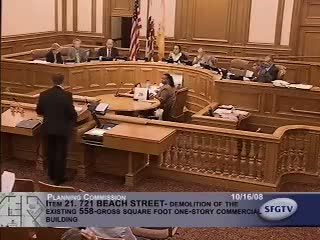
Neighbors press for EIR as Planning Commission upholds 721 Beach Street PMND
Summary
After hours of public testimony citing parking, height and views, the Planning Commission voted unanimously to uphold the amended preliminary mitigated negative declaration for the 721 Beach Street project, while several commissioners said staff should consider initiating discretionary review later.
The Planning Commission on Oct. 16 upheld the Planning Department’s amended preliminary mitigated negative declaration (PMND) for a proposed demolition and four‑story mixed commercial‑residential building at 721 Beach Street after an extended public comment period in which residents urged recirculation or a full environmental impact report.
The appeal hearing opened with the project opponents arguing the revised PMND was circulated too late for public review and failed to analyze significant impacts on parking, traffic queuing, private views and cumulative visual effects. Appellant Terry Watt told commissioners the PMND did not propose feasible mitigation and urged a 30‑day recirculation or an EIR. Neighbors and associations including Aquatic Park Neighbors and the Russian Hill Improvement Association presented computer simulations and block surveys, saying the proposal would violate a local 40‑foot character and create precedent for taller, view‑blocking buildings.
Project counsel and Planning Department staff countered that CEQA requires evidence of a significant impact and that the amended PMND did not add new unmitigated effects; staff said the document contained additional analysis but no new mitigations or conclusions that would require recirculation. The project sponsor’s attorney argued the appeal relied on speculative or non‑CEQA issues (private view impacts, building design) and said the PMND complies with CEQA.
Commissioners questioned aspects of the proposal, including occupied floor area calculations and whether retail square footage had been arranged to avoid a commercial parking trigger. Staff explained that parking obligations examine "occupied floor area" and that projects are reviewed again at tenant‑improvement stage, when parking triggers are enforced if occupied commercial area expands. Several commissioners expressed sympathy for neighborhood concerns about parking and design and encouraged the project sponsor to engage in further outreach.
After deliberation, Commissioner Sugaya moved to uphold the PMND and the motion passed unanimously. Commissioners also discussed a staff‑initiated mandatory discretionary review; some said they expected the project would return under discretionary review if neighbors sought it, and on staff recommendation the commission asked that the variance be separately re‑noticed when (or if) discretionary review is filed.
Outcome: PMND upheld, with the commission and staff noting neighborhood concerns and leaving open avenues for further review during permitting or discretionary review if requested.