Get Full Government Meeting Transcripts, Videos, & Alerts Forever!
Get email alerts on the Carbon Tax topic
No spam. Unsubscribe anytime.
Mayor’s office explores revenue-neutral carbon tax but sector impacts complicate plan
Summary
At the Planning Commission hearing, the mayor’s office outlined a revenue-neutral carbon tax concept that would swap higher energy/user taxes for payroll tax relief; officials said sectoral impacts (e.g., biotech, bakeries) and ballot timing create major calibration challenges.
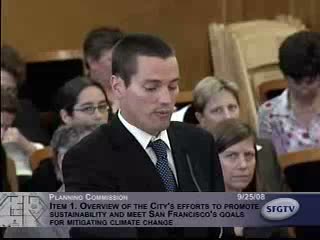
Wade Crowfoot of the mayor’s office described an early concept for a revenue-neutral carbon tax that would shift the city’s tax emphasis from payroll tax toward taxing energy use in commercial buildings, with the goal of incentivizing lower energy consumption while offsetting the revenue loss by reducing payroll taxes.
Crowfoot framed the idea as: “We pay, we actually charge a payroll tax to local businesses. So we’re essentially taxing something that we want to encourage, which is salary and payroll and jobs. So why not increase taxes on something that we want to discourage, in this case, energy use, and then being able to actually make a corresponding decrease in the payroll tax.” He emphasized that the idea is still being refined.
Commissioners pressed practical issues. Commissioner Michael Antonini asked whether payroll-tax relief could instead be achieved by lowering the payroll tax itself; Crowfoot said both approaches are under study and that the initial carbon-tax proposal raised unintended sectoral impacts. He gave bakery and biotechnology businesses as examples of sectors with high energy use relative to payroll, saying an uncalibrated swap could unfairly penalize industries the city wants to encourage.
Crowfoot noted a procedural constraint: changes to local taxation would need to be timed with the city’s election cycle and supervisors’ races, meaning the city would effectively have one opportunity every two years to put a tax-change measure on the ballot. He said the administration is assembling a task force to refine the policy and work through calibration and equity issues before any measure would be proposed.
The discussion made clear that while a local green/pricing signal is under active exploration, officials expect significant technical, economic and political work ahead, and that any eventual proposal would be preceded by public analysis and stakeholder outreach.